Why and How ‘Manhunt’ Depicts Hell as a “Colorful Candy World”: A Chat With DOP Jonathan Glendon
A competition film of the 79th edition of the Locarno Film Festival that left audiences rattled and talking well past the lights came on after the movie was Wayne Wapeemukwa‘s sophomore feature, Manhunt.
Inspired by real-life murders in Canada in 2019, the film follows two young men who try to escape dead-end lives by embarking on a road trip through the country’s northern frontier, which ends up as a journey with much, much bigger – and darker – consequences for people around them and themselves.
Manhunt caused much debate among Locarno audiences by not compiling facts but offering a parable and diving into what Wapeemukwa described in a THR interview as the “nihilism at the heart of these boys’ lives. Online, we call it being blackpilled.” The film picked up an honor in Locarno’s Junior Jury Awards.
Also turning heads in Manhunt, which Wapeemukwa wrote with Anna-Lena Theobald, were Canadian newcomers Harris Lowe and Landon Tunold, discovered by the team of Vaka Street Casting, which was also behind the Canadian hit Blue Heron, as the young male protagonists, along with L.A.-based Austrian twins Bianca and Dilara Foscht.
And then there is the cinematography, courtesy of Toronto-based Jonathan Glendon in his feature film debut. Sensory and visceral, mesmerizing and unsettling at the same time, the movie’s visuals mirror the state of mind of the two guys at its center, earning the DOP all sorts of questions during a discussion after the Locarno world premiere of the film.
Cinetic Media holds North American sales rights, while Aspect Ratio is handling international sales.
About a month after the film’s premiere, THR caught up with Glendon in between all sorts of work projects to discuss how he approached the cinematographic look and feel of Manhunt, inspirations from Dutch cinematographer legend Robbie Muller and The Wrestler, the use of saturation and infrared light, and why he and Wapeemukwa imagined hell as a colorful candy world.
This is your first feature film. How did you end up coming on board as cinematographer for it?
There were a few things happening all at once. I knew the casting director of the movie, Katrín Braga – we have been friends for almost 10 years now. She specializes in street casting and sometimes sends me amazing photos of people she comes across for photography or film projects. Before Manhunt, she sent me a photo of Harris and Landon without saying anything, and I responded with: “Who are these guys? They look amazing and so interesting.” They had this crazy look, and their chemistry just in this photo was obvious. There was so much energy in it.
And she responded by asking: “What are you doing in August?” And I said: “Nothing. What do you mean? So, sounds good – [whatever you need].” And then the next day, the producer of Manhunt called me and said he would get the script for the film over to me, and it would be amazing if I could call the director, Wayne. I didn’t know what he was talking about, so he said: “Oh, you were recommended by Jeremy Cox, [the DOP on the likes of Backrooms and Longlegs], who was going to shoot the film, but he can’t and suggested you, and Katrin suggested you as well.” Of course, I said: “I would love to talk to the director.”
I ran home from a cafe because I felt I needed to read the script and prep in my office. Because this is my first feature, I really wanted to be as prepared as I could. When I called Wayne, it was just supposed to be a 15-20 minute chemistry call to discuss our approach and interests. But we ended up talking for an hour or an hour and a half and just immediately clicked. We had so many ideas to share about how we could approach some of the subject matter in a way that made it powerful, while being conscious of the world and the politics around the film.
While watching Manhunt, I felt the film quite intensely. It was more of an all-around experience – there was a chemistry and physicality to it. How important was that to the creative team? And did you have any cinematic references for that?
I’m so happy that you use the word “feel” for how the movie is interacting with you! I love that.
Let’s talk about color in that context. I don’t think you should ever notice color in a movie, unless that’s a story beat. But it’s really important for the color to be felt. I was really inspired by the way that Robbie Müller shot Breaking the Waves, the Lars von Trier film. I remember watching that movie for the first time and for the first five minutes wondering: Why is the movie this sepia, this brown thing? And five minutes go by, and you completely forget about the color, but you still feel it, and the feeling is this bubbling, horrible anxiety. It’s like poison, like rot. It’s not loud, but your eyes are so good at adjusting to the world that when your eyes adjust to rot, you stop seeing it and you start feeling it.
So, when we made Manhunt, we really wanted that feeling of an unsettledness to be felt. So, for Act 1 and Act 2, we are very referential to Breaking the Waves. The colorist, Dave Tolmiak, and I funneled the color away. It starts off quite muted and a little bit brown, and then we take a little bit more color away, a little bit more color away, a little bit more color away, a little bit more color away, until the moment before Act 3 starts, where there’s a pivotal moment in the movie where the two characters decide the way they want their life to be. They have the choice of acting upon evil, or of stepping back from the edge.
At that point, the movie has almost zero saturation, and you don’t see it, but you feel it. You feel that there is no life left in the image. And this also works narratively within the film because there is a forest fire.
And then there are some wild-looking colors in the final act. Where does that come from?
We talked quite intensely about the ways in which hell could be represented, which is the third act of the film. That’s when the colors come – these crazy red skies and yellow trees and strange skin tones. It’s like we’ve gotten so used to the color being gone and to having this horrible feeling inside. I have described it as wanting Act 2 to feel like sand in your mouth – that textural feeling of grittiness and dryness, this unquenchable desire to change something, but you don’t know how.
And then, I wanted Act 3 to be this candy-like hellscape. That was something that Wayne and I connected on early on.
I’m fascinated by this idea of hell being a bright candy world… Can you tell me more about that?
Working on Manhunt brought up a lot of philosophical questions and made me think a lot about what hell is. I realized that hell is actually different for everybody. Traditionally, there’s this rendering of hell as a dark cave with fire, and there’s the devil with a pitchfork poking everybody with it. That’s the sort of hell that we accept in media. But I realized that hell, just like heaven, is an incredibly personal experience – one person’s heaven is not another person’s heaven, and the same is true for hell.
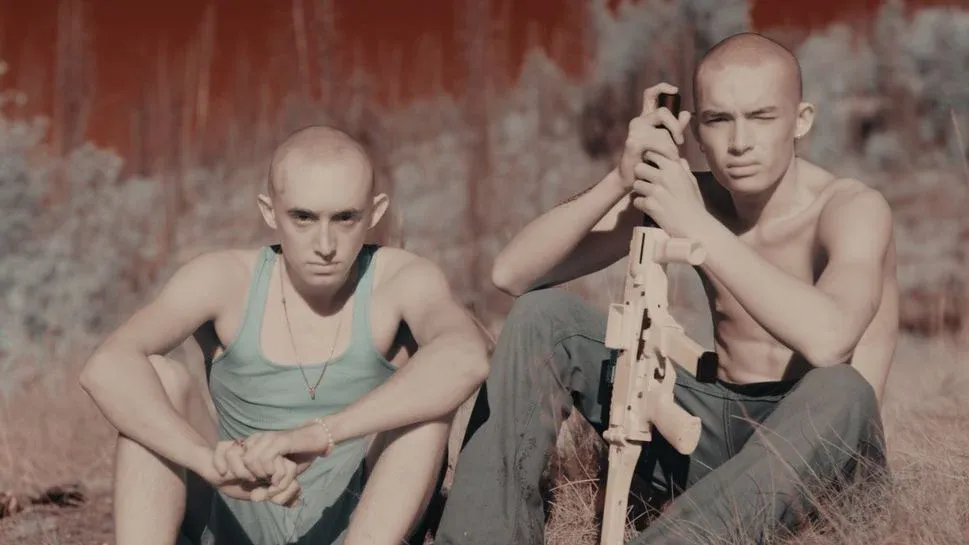
For our two main characters, their version of hell is kind of awesome in some ways. They make this choice willingly, and by doing so, they are, for a moment, in this bright, colorful candy world – this Monster Energy drink-, Mountain Dew-like pornographic space where everything is in full saturation, full brightness, full energy, full excitement.
But when you eat too much candy, you get this headache, and you can’t sustain that sort of explosion. So, we wanted to represent hell in this brighter way.
How did you achieve that psychedelic look and feel?
When Wayne initially suggested that hell was like candy, I thought about how we could use cameras that saw outside the visible spectrum. So all the colors that you see were from an infrared camera, and we got multiple effects from doing that. On the surface level, you get these incredible skies because infrared light is invisible to us. There’s far more infrared light on Earth than there is visible light, so you just get these bright vistas. And everything has a different relationship with infrared light. Trees, for example, have their chlorophyll interacting with infrared light in a very special way that makes it glow. So, with in an infrared camera, you get trees with vibrant purple or bright orange.
I really love the work that Greig Fraser did on Dune: Part Two with the Colosseum scene, this black-and-white fight that uses infrared cameras and sees under the surface layer of the skin. I was really curious as to how that would look in color because black and white looks really beautiful. With color, it sort of makes people look like a newborn – their skin becomes wrinkleless and slightly translucent. And because we all produce heat, we also all produce a small amount of light, and it creates this very strange skin texture of a newborn baby mixed with a snake. And I thought that was very fitting for these characters, born again into hell.
You mentioned photography before. Were there any inspirations from that or other creative fields that you brought to Manhunt, especially when it comes to the use of infrared light?
I was initially really inspired by photographer Richard Mosse, who did this project on color infrared film stock that I really loved. I saw it in university and have always really admired it. It is called The Enclave. But that’s the only infrared color project that is in a narrative space that I was aware of. There are also a couple of music videos that have done it and a dance film from Montreal that I found that used infrared mixed with thermal imaging. But this is a camera technique that is more popular with photographers who shoot landscapes. So, there’s a novelty to it.
Our director Wayne and I were just really interested in creating very visceral spaces, showing the deadness in the world.
Since this isn’t a big studio project, how did you and the rest of the creative team on Manhunt get all this stuff done on a small budget?
So many things came out of our nimbleness in filmmaking. We didn’t have very large lighting setups, so we really chose the time of day when we wanted to shoot.
And for the last part of the film, the director, myself, the first First Assistant Camera, the actors, and the producer, we all actually camped for a week. We had a tent set up that had the camera in it overnight, and we had giant batteries that would charge smaller batteries. We did that so that we could gain access to these locations that were four or five hours away from any hotel in the middle of nowhere in the Rocky Mountains of Canada.
I recall that you also mentioned during a Locarno Q&A that Darren Aronofsky’s The Wrestler was an influence for parts of Manhunt in some way. Could you share how?
That film was shot by Maryse Alberti, and it’s some of the best handheld camera work I’ve ever seen. I really think it’s so perfect. I love the aspect ratio and the physical space that Mickey Rourke takes up in the movie. A lot of the movie is shot from behind, showing Mickey Rourke’s character move through the world, and so we see the world in front, but we don’t always get to see Mickey’s face in it. His physicality is his relationship with the world. So, you don’t fully get to know his character. And then the moments where you do get to come around, and you do get to see him from the front, you get a close-up, and it feels like a gift.
When Wayne, the director, and I were talking about Manhunt, we talked a lot about the visual language and how we could create rules to confine us. We both really believe that creativity shouldn’t be limitless. Creativity actually lives most powerfully when there is some confinement, some restriction.
One of the rules that we made was to restrict the visibility of Joey and Kit in the first two acts. We wanted to see them from behind and obstruct them a little bit. We wanted to see their relationship with the world, and only in some instances do we show them fully.
In the third act, when they make this terrible choice of who they want to be, that’s when we fully get to meet them. That’s when the movie stops being handheld, and the film fully becomes static on the tripod with wides. And we slowly get further and further away from them, as if nature and the environment are consuming them. We show the scale of nature to show how minuscule they are.
Manhunt also includes video game segments, which take us inside the digital world, where key ideas and thoughts of the main characters form. How did you guys approach that?
That part of the film was done by a really talented, recently graduated video game developer I had met at a party in Toronto. We always knew that there was going to be a Manhunt video game that they’re playing for the relationship between the two of them, and to have the game rendering their life, and their life rendering the game. There is this foreshadowing as to who they’re going to be in the video game; the skies in it even resemble the skies in Act 3. We shot the film first and gave this developer scenes and stills from it, so he could model the video game after the forest and the color palette we shot in.
Before I let you go back to your work, will we see more feature film work from you – or are you at least open to it? And any genres or so you are particularly interested in?
Yes, the narrative space is definitely where I want to be working. Since Locarno, I’m really happy that I’ve been in contact with people about projects.
I think the movies that I’m drawn to and that I hope to connect with are about spaces and approach, not genres. I really want to work on films that don’t fully know yet what they are. I want there to be a little bit of room where hopefully the director and I can create something together. I also love working with non-actors. I love films that are approach-driven, and I love directors who are open to creating rules. That’s really important for me. So, I’m very grateful to be interviewing for some movies right now, because I want to keep it going.

Related Posts
Hannah Einbinder Says Speaking Out for Palestine Is “the Bare Minimum”
How Pat McAfee Landed His First Acting Role in ‘The Mosquito Bowl’ — With Some Help From Bradley Cooper and Tom Cruise