‘The Drop: A Snowfall Saga’ Review: FX’s ‘Snowfall’ Spinoff Offers a Promising, if Uneven, ’90s Hip-Hop Odyssey
Late in the run of FX’s Snowfall, debate sprung up in a passionate corner of the fanbase regarding whether or not the Los Angeles-set drama about the birth of the crack epidemic in the 1980s was as good as (or better than) HBO’s The Wire.
Read more Tokyo Film Festival Adds New Initiatives, Kashiko Kawakita Award to Honor Women in Cinema
It was not.
The Drop: A Snowfall Saga
Less ambitious than ‘Snowfall,’ but easy to jump into.
Cast: Gail Bean, Isaiah John, Asante Blackk, Peyton Alex Smith and Simmie Sims III
Creator: Malcolm Spellman
Snowfall equalled The Wire mostly in terms of volume — 60 episodes apiece — but over the course of its six seasons, the topical and thematic similarities were obvious and the structural similarities even more so. Both series were novelistic in their storytelling approach, weaving a layered tapestry of plotlines and characters with enough care that the end results — both individual seasons and the shows overall — were more than the sum of the episodic parts.
What Snowfall lacked in cohesion, it reliably made up for in audacity and ambition.
If the individual story arcs were never of equal quality — the rise and fall of drug kingpin Franklin Saint (Damson Idris) was consistent, while the threads relating to the Mexican cartels and the meddling of the CIA surely were not — the series offered a wide variety of pleasures to compensate. The events might have adhered too closely to the Peak TV Antihero Playbook, but you could also concentrate less on what Franklin Saint was doing — hitting moral rock-bottom over and over and over again — and more on how Idris was playing the character’s transformation.
If the conspiratorial indictment of the U.S. government wasn’t always convincing, the South Central atmosphere, period details, soundtrack and deep, previously unproven ensemble mostly were.
Arriving more than three years after Snowfall concluded, The Drop: A Snowfall Saga isn’t always the most logical of franchise spinoffs. Given how few of the key figures from the original series survived to the end — they were, after all, caught up in a drug crisis that killed countless people — it isn’t surprising that the focal characters in the spinoff have a “last man standing” feeling; Wanda (Gail Bean) and Leon (Isaiah John) earned the honor by attrition as much as merit.
In shifting its interest from the drug game to the music industry, The Drop: A Snowfall Saga has lower stakes than its predecessor and, despite a large ensemble, lacks any single performance as dynamic as what Idris delivered in Snowfall. The novelistic approach, with A, B and C stories that moved parallel, then flirted and finally crashed into each other with tragic consequences, has been replaced by something simpler and cleaner, less capable of reaching the earlier show’s impressive highs but seemingly less prone to the frustrating lows as well.
The Drop: A Snowfall Saga is, through the five episodes sent to critics, uneven in its own ways. The series looks and feels right, the soundtrack is almost nonstop bangers, and whether you recognize all the actors or not, every piece of the ensemble conveys authenticity. The mounting doom that gave Snowfall its momentum and its inevitable destination is absent and often missed. So far there’s ample potential here, and given that it took Snowfall a little while to fully lock into its identity, this potential might be even more exciting because it’s harder to anticipate where this saga is going.
If you weren’t captivated by Snowfall or just never had time to watch, The Drop doesn’t really require all that much pre-existing information. It isn’t until the fourth episode that anybody sits down with pictures of the characters from Snowfall to lament the passing of time. That fourth episode is also the first instance that anybody starts directly explaining how the rap game and the drug game are similar, which you’ll probably have figured out already.
Generally, creator Malcolm Spellman and his writers have chosen an approach that borders on fully standalone.
We pick things up in Los Angeles in 1990.
Wanda (Bean) is working at a used car dealership, but she dreams of breaking into the music business. She hasn’t left the neighborhood, despite the stigma that comes from her former addiction to crack, which is all you need to know about her arc from Snowfall.
She and Leon (John) have separated, but they’re still close, bonded by the events from Snowfall, which are gradually touched upon, as well as a shared trauma, which is touched upon as well. Leon is still working at a legal clinic and The Drop isn’t always sure how to bring him into the new show.
Gail moonlights as an assistant to Brandon Mychal Smith’s DG, an executive at Macroscope Records, a struggling label run by Jenny (Isidora Goreshter), the daughter of the absent founder. DG and Gail are convinced that hip-hop is the key to saving Macroscope, which isn’t a huge stretch given that Straight Outta Compton came out nearly two years earlier. A flannel-wearing white executive protests that grunge is actually the future, which is kinda more impressive given that Nevermind, Badmotorfinger, Ten and Dirt haven’t come out yet. But he’s the villain and Gail is the hero.
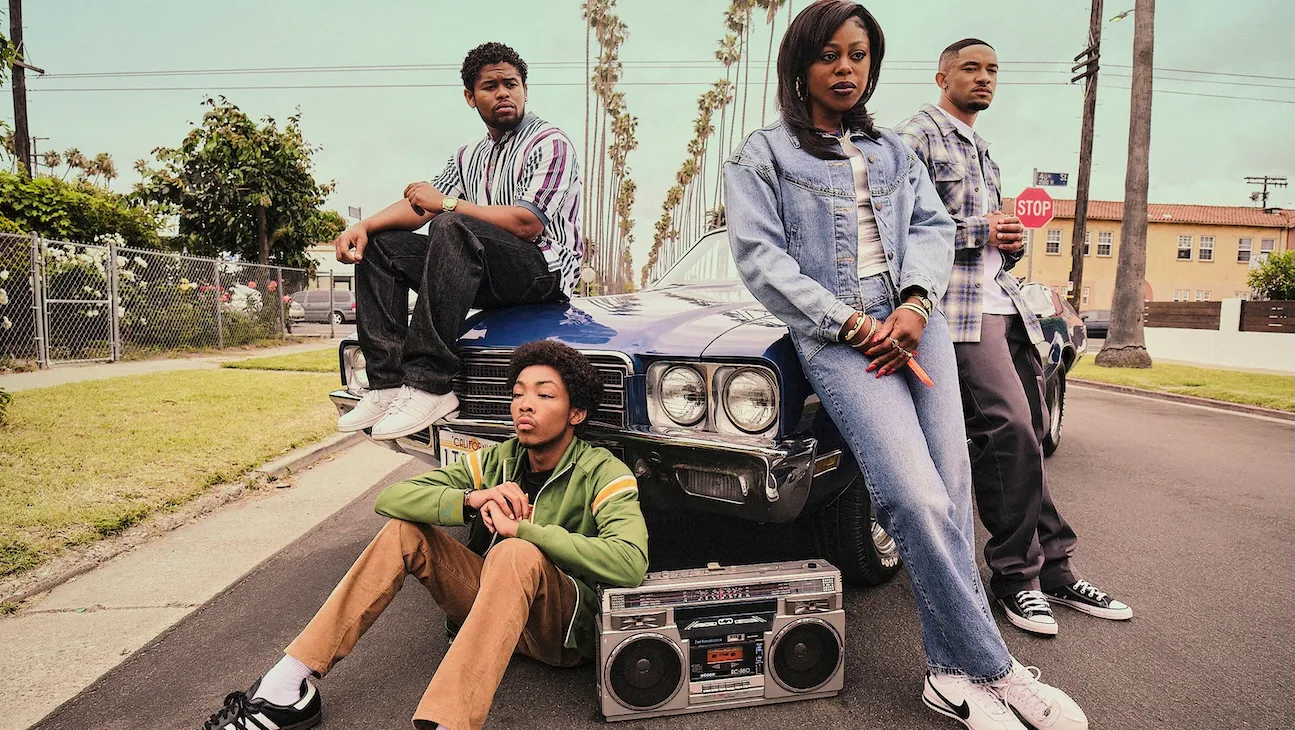
Going through demos, Gail finds a tape recorded by Artillery (Simmie “Buddy” Sims III), a gangbanger and street poet already causing trouble with a song about recent police violence. Gail thinks she could have a hit by pairing Artillery with her cousin Lamar (Asante Blackk), a musical savant whose artistic dreams aren’t supported by his grandparents and guardians (Mykelti Williamson, Nicki Micheaux), who would prefer that Lamar and his trouble-prone brother (Peyton Alex Smith’s James) dedicate themselves to work and the church.
It turns out, not surprisingly, that Gail is correct, that combining Artillery and Lamar’s gifts creates magic, but in inner city L.A. in 1990, magic might not be enough.
Setting the story in 1990 — already up to early 1991 by midseason — teases certain upcoming historical signposts, especially with tensions with the police already simmering. The Rodney King beating is just episodes away, I’m assuming, while the 1992 uprising is presumably on the board as a major second season event.
Musically, though, The Drop finds itself in an odd nether-space. Straight Outta Compton has already come out (and Ice-T’s 1987 debut Rhyme Pays is already practically an oldie), with Efil4zaggin and then 2Pacalypse Now months away and The Chronic and Doggystyle a bit further down the line. The tremendous soundtrack has already decided that “time” is an emotional construct, going from chronologically specific needle drops to new artists like Kendrick Lamar to confusing picks like DJ Pooh’s “Whoop Whoop,” a 1997 release whose lyrics, including “I put my trust in you like the OJ jury,” are either long-term foreshadowing or just anachronistic.
Snowfall was propulsive because while Franklin Saint didn’t invent crack cocaine — RZA made an unintentionally hilarious cameo in the first season as the master chef who cooked that shit up — he pioneered it, placing “doom” on the permanent horizon. But who is Artillery supposed to mirror and how does the show want to approach his journey? It’s unclear, and the momentum suffers from it. He’s talented, but not an innovator, so if he isn’t making the game or changing the game, what is he doing? How should viewers be responding to the two singles we’ve heard? They’re good, but are they great? How would that even be measured? And could the show function in exactly the same way without Wanda and Leon being present at all? Is it bad if your two most visible characters could be removed from the plot without any loss?
Thus far, The Drop is biding time, albeit entertainingly. The new series is so thoroughly without a clear direction that when the fifth episode rolls around and it’s primarily a flashback to the origin story involving Lamar and James’ ill-fated mama (Denée Benton), simply pausing the main story for an hour is easy. Actually, it’s almost an improvement because Benton is spectacular in this one-episode appearance as a woman whose genius and mental struggles may be the brothers’ shared genetic legacy.
Carrying the show in the early going are Blackk, bringing a quirky and often humorous energy, and Smith, an instantly commanding presence. Williamson and Micheaux are underutilized, but bring dramatic heft when they’re around. I was intrigued by Aleyse Shannon as Dara, Artillery’s possibly scheming manager, and I chuckled a lot at Eric Balfour as a slimy lawyer who apparently just hangs out with DG — neither the show nor Brandon Mychal Smith have quite figured the slickly abusive DG out — in fancy suits.
When in doubt, series directors including Snowfall veterans Ben Younger and Alonso Alvarez–Barreda just capture the pulsating vibes of early ’90s South Central. In a TV landscape that leans too frequently into underlit, washed-out cinematography, The Drop is bright and flashy, if visually derivative of the aesthetic that Snowfall co-creator John Singleton forged going all the way back to Boyz n the Hood.
Will that cinematic landmark play a role in The Drop? Will the spinoff forge a voice and destination of its own? Or will it only offer a ’90s musical vibe? What it’s doing probably won’t be enough forever, but it’s a promising start.
Read more Padel Spanks Pickleball: Inside the Rise of the New Celebrity Sports Obsession