‘Queer Edward II’ Review: Footage of the Making of Derek Jarman’s ‘Edward II’ Finally Sees the Dark of Cinema in a Wondrous Documentary
This delightful if darkness-tinged documentary is comprised of footage shot by then not yet fully-fledged cameraman Seamus McGarvey (who went on to be DP for Atonement and The Hours among other features) on the set of Derek Jarman’s 1991 adaptation of Edward II. For reasons not explained here, McGarvey’s material was left sitting in a cupboard for 30-odd years, unedited into the making-of documentary it was meant to be, even after Jarman’s death from AIDS-related illness not long after Edward II came out.
But maybe all things happen for a reason because now, thanks to young British director Theo Rollason and their team, the original footage gets to be part of a larger documentary. Filled out with vintage archive that supplements the portrait built here of the irrepressibly charming Jarman and his highly talented team of collaborators, this easily tallies up as more than the sum of its parts. It’s also guaranteed to induce swooning nostalgia in those who remember queer life, London and the filmmaking scene thereof in the early 1990s. Those too young, like Rollason, to have lived through those thrilling if dangerous times will have to contend with the complicated jealousy this will induce. And hopefully take away sadly timely history lessons about the necessity of resisting despotic, homophobic authoritarians, especially if you can do it with men dressed as nuns.
Queer Edward II
An insightful and delightful nostalgia trip.
Director/screenwriter: Theo Rollason
Producers: Ben Fowlie, Sebastien Rabas, Michael Sherman
1 hour 37 minutes
Fans of Jarman can spend happy hours debating which of his features — Latin-language trailblazer Sebastiane, punk fetish object Jubilee, irreverent The Tempest, painterly Caravaggio, to name just a few — is the best, and Edward II definitely has its passionate defenders. It certainly deftly collated together key Jarmanian features, such as giving an English Lit classic (Christopher Marlowe’s 16th century play) a pointedly political contemporary frame, mixing opulence and austerity in its sets and costumes, and serving up lashings of hot boy-on-boy action and a diva or two. (Annie Lennox has a walk-on moment singing Cole Porter’s ‘Ev’ry Time We Say Goodbye.’)
As is pointed out here, this was also his most expensive feature up until then, costing about £900K, hardly a princely sum even then. Presumably a goodly chunk of that change went to proper professional actors (including Steven Waddington and Andrew Tiernan as Edward and his lover Gaveston) who could cope with the Elizabethan verse, as well as regular Jarman chums in the cast like Tilda Swinton, who played Edward’s sulky French wife. (She looks unspeakably radiant here in Sandy Powell’s gorgeous costumes.) But McGarvey also captures the comic horror show of low-budget filmmaking in Britain at the time as one producer dips into his own pocket to pay off some bolshy background artists demanding extra to cover their expenses.
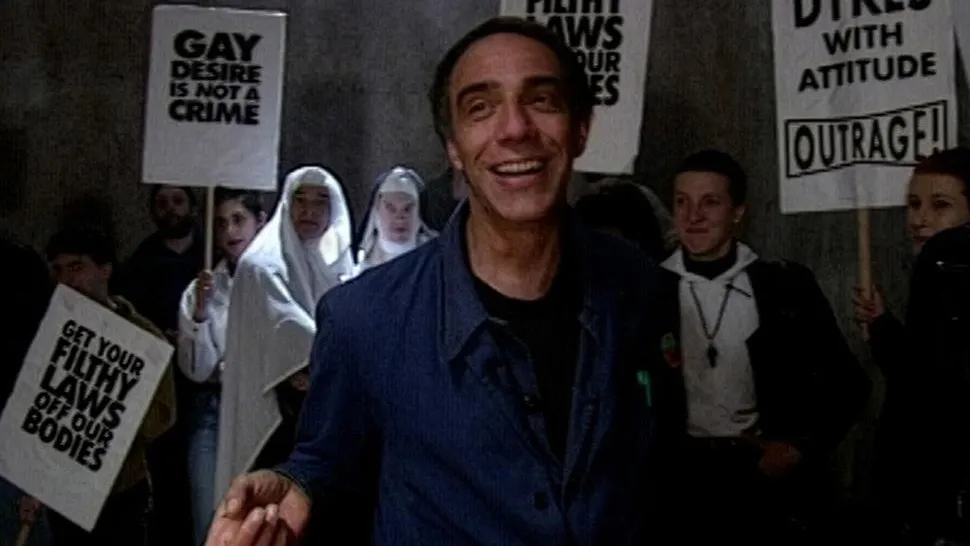
Indeed, the footage of the harried production staff trying to keep the show going on from the office at Bray Studios where the shoot is happening sometimes plays like a vintage workplace comedy but with a dark undertow. The highlight is the sequence where visiting extras from the queer activist group Outrage! decide to invade a neighboring studio where popstar Cliff Richard, long rumored to be gay, is rehearsing and offer him keys to help him come out of the closet.
At first, it all looks like juvenile hijinks, the attempted outing (all the rage in those days) now looking very much not cool to contemporary eyes. Jarman, when told about it, looks more like he’s trying to keep a straight face than channel censorious disapproval. But when someone leaks the story to the tabloids and the scandal threatens to shut down production if Richard sues, it’s suddenly not such a lark, especially for production manager Sarah Swords, who’s left manning the phones, trying to negotiate with the tabloid reporters the way a canary negotiates with a cat.
Luckily both for Swords and the film itself, and of course this documentary about the film, the whole thing blows over and the team goes on to fight other battles and make more films. Younger viewers and those not from Britain will learn here about Clause 28, proposed legislation that would criminalize the “promotion of homosexuality” in state schools, which campaigners such as Jarman, the Outrage! protesters and many others fought hard against. (It did become law but was repealed in the 2000s.) The footage here follows Jarman as he and others voluntarily “surrender” en masse to London police stations as a publicity stunt, the kind of disruptive, playful non-violent intervention that’s all too thin on the ground these days, in both the U.K. and offshore.
Rollason and fellow editor Nicole Halova, with supervision provided by the legendary longtime Werner Herzog-collaborator Joe Bini, effortlessly weave this material into the filmmaking story, underscoring how intimately intertwined politics, protest and art were at the time — a rebellious spirit of the times that will induce nostalgia almost as much as the intarsia knitwear and early ’90s haircuts seen here.
Read more John Malkovich Returning to Israel With ‘The Music Critic’