Lucas Museum Review: A Bold Throwback to Gilded Age Patronage
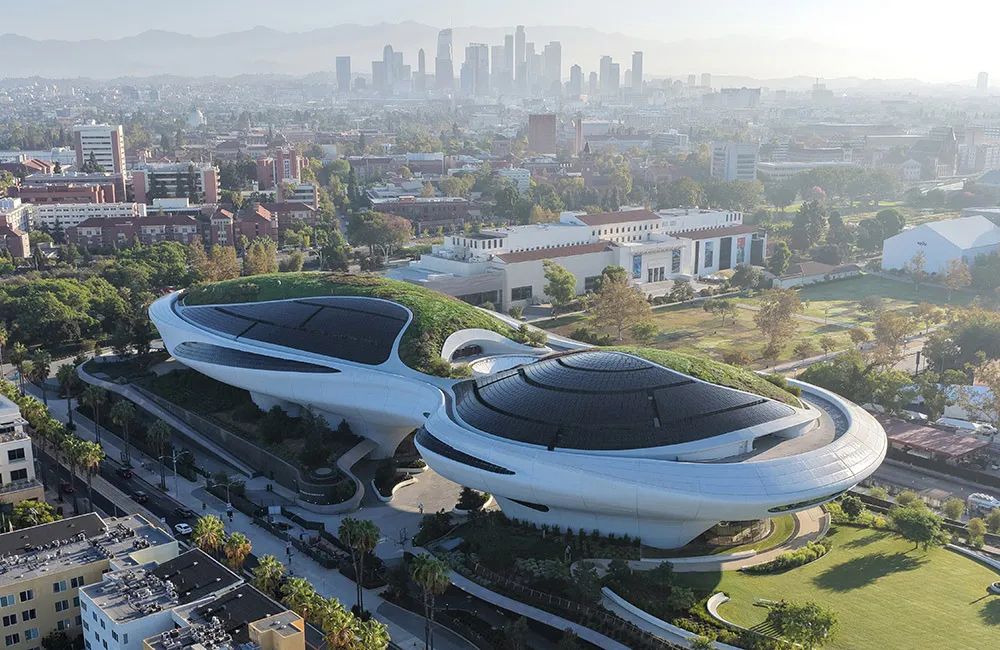
George Lucas knew he needed a hook — the requisite fan service — at his new Lucas Museum of Narrative Art in downtown Los Angeles. That’s why there’s a large main gallery full of Star Wars crown-jewel production pieces, from R2-D2 and Darth Vader’s suit to podracers galore. The collection of his own artifacts is at once ego monument as well as a reminder that this billion-dollar institution wouldn’t be possible without the culture-defining, fortune-making commercial success he achieved in Hollywood.
It also makes perfect sense under the intellectual and idiosyncratic terms of this oddball personal endeavor, a final-act provocation which only someone with fuck-you money can realize at such colossal scale and scope. A museum as Megalopolis. The approach taken by Lucas, 82, is a striking throwback to the rich, eccentric autodidact’s cabinet-of-curiosities concept associated with Gilded Age figures like Henry Clay Frick, Henry Huntington and P.T. Barnum. But it’s also a distinct expression of Lucas’ own artistic influences and impacts.
Lucas has taken an increasingly strong hand as the museum’s Sept. 22 opening neared. (His wife, the prominent business executive Mellody Hobson, has also been deeply involved.) In 2025, when its inaugural director-CEO as well as its chief curator departed, Lucas assumed direct creative control and remains the lead curator. The project ended up in L.A. after earlier efforts to develop it in San Francisco and then Chicago failed, in part due to the billionaire filmmaker’s unwillingness to compromise with opponents of his plans. “I’m a contrarian” is how Lucas put it at a press conference on Sept. 2. “I don’t like to do things that people think can be done. I’m fascinated by doing things that people say can’t be done.” He added, explaining that the endeavor had taken 17 years, “This one almost broke my will.”
His populist mission is grand: ignoring precepts about high and low culture in favor of a pop-culture-centered focus on “narrative,” which is to say storytelling. He’s referred to what he terms “narrative art” as both “an illegitimate child of art — you won’t see it in any [existing] major museum” to Vanity Fair in 2018 and, more affirmatively, “the people’s art” at a San Diego Comic-Con panel last year. Detractors are likely to scorn him for canonizing what they consider kitsch. (In 2017, when the museum’s L.A. location was first publicized, the Los Angeles Times art critic Christopher Knight wrote a piece deriding Lucas’ plan as “the Treacle Museum — a sentimental vanity gallery pumped up on soppy emotional steroids.”)
In practice, Frida Kahlo paintings mix with Garfield comic book panels in the same conceptual universe. Elsewhere, Lucas does things like situating Norman Rockwell’s famous “The Runaway” (1958), depicting a friendly policeman speaking to a white boy, beside Richard Williams’ recontextualized “The Militarization of the Police Department” (2014), depicting a menacing modern-day cop intimidating a black boy.
The museum is a clear extension of Lucas’ auteurism. He spent his film career not just world-building on screen but creating an ecosystem of institutions like Industrial Light & Magic, Skywalker Sound and Lucasfilm. Here, his Hollywood retirement project is a Gesamtkunstwerk, or total work of art, in which “narrative” is the Wagnerian organizing principle. In his telling, its creation was analogous to the way a film is put together: casting is the collection, scripting is the curation, editing is the installation, and architecture and landscaping are the production design. “It’s like making a movie — exactly the same thing,” Lucas explained to Vogue in May.
Read more Maybe Paramount-Warner SHOULD Leave L.A.
The Lucas Museum isn’t unique for being named after and guided by its founding benefactor. In L.A. alone, there’s the Getty, the Broad, the Marciano Foundation and others. Instead, it reflects a far rarer, at times impudent, even radical tradition of pioneering patrons whose emphatic prerogatives have helped redefine our culture.
These include Albert C. Barnes, who insisted the collection of modern European art at his Barnes Foundation in Philadelphia would be shown based on formal visual relationships like line, light, color and shape rather than conventional categories such as chronology, as well as Boston’s Isabella Stewart Gardner Museum, whose namesake made binding curatorial and presentational decisions. Then there’s Bill Paley, founder of CBS, who in 1975 established what became the Paley Center for Media, with a thesis bearing a similar egalitarianism to Lucas — that lowly radio and TV were, in fact, artifacts worth serious attention — and Walmart heiress Alice Walton, who 15 years ago opened her well-endowed Crystal Bridges museum in Arkansas to decentralize and democratize the country’s fine art scene.
The Lucas Museum feels, too, like another category of U.S. civic institution — presidential libraries established by still-living commanders-in-chief. Only with the distance allowed by their subjects’ deaths do these institutions truly mature. (For instance, one day the Star Wars exhibition may dispassionately examine Jar Jar Binks and how the character’s reception affected the career of its actor Ahmed Best.)
Until then, the presence looms. Exhibit A: In 2016, Kathleen Kennedy, then running Lucasfilm at Disney, said there would’ve been no notorious “slave Leia” costume “with a chain around her neck” under her reign. Hobson responded that her husband was “not apologetic about the bikini” and “would probably do the same thing today.”
A massive, commissioned work entitled Princess Leia Frees Herself from Jabba the Hutt is now situated in the most prominent spot at the Lucas Museum’s vast outdoor sculpture garden. It’s a faithful recreation of the iconic scene from Return of the Jedi — rendered in bronze, for posterity.