In Her New Movie, Carrie Coon Plays an Unexpected Cult Member: It’s Easy to Say “No Way That Would Ever Happen to Me”
It was ten years ago that filmmaker Guy Nattiv felt ready to direct what he calls the “most personal movie I’ve done in my life.” But it took that full decade to get it to the screen.
Read more Nicolas Cage’s ‘Spider-Noir’ Canceled by Prime Video After One Season
The director, who won an Academy Award for his short film Skin and then went on to direct a feature of the same name, as well as films such as the Golda Meir biopic Golda, wanted to tackle a film inspired by the story of his grandmother, a Holocaust survivor who, in her middle age in the 1980s, joined a cult and made the decision to leave her family in Israel to follow its charismatic female leader to the United States, where she would later die.
Nattiv was young when his grandmother started to participate in activities held by the cult, which included talks, seminars and free dancing sessions. As a child, he was occasionally brought along to some of these events. “I didn’t exactly understand [what was happening],” he says. “I remember they took me out of school for seminars to dance with other people in a hotel room and stuff like that.”
Years after his grandmother departed for the US and later passed away, Nattiv, by then a film school graduate, read her diaries and letters and began researching the cult, eventually traveling to the location of its one-time Virginia compound and meeting with the relatives of other members. But he still felt unprepared to tackle the story, saying, “I wasn’t emotionally developed enough to dive in.” In the interim, he collected an Oscar and started a family, welcoming two children of his own. With this life and filmmaking experience, he finally felt ready.
Then, when he sat down to write the screenplay, he had a panic attack.
“My wife had to take me to the hospital. I didn’t understand. I am like, ‘Why can I not breathe?’” remembers Nattiv. In time, he realized, “I felt my grandmother. I felt her misery. I felt how she was torn, and the darkness of it.”
It is this deep-seated empathy for a complicated woman, who survived the darkest moment of the 20th century and attempted to find personal salvation but ultimately entrusted that deliverance to the wrong person, that is the engine for The Liberation. The movie is making its world premiere at this year’s Telluride Film Festival before being released by Bleecker Street.
“What I felt from Guy in our initial conversations, and also in the script, was his compassion for his grandmother,” says Carrie Coon, who in the film plays Rita, the onscreen character that is inspired by Nattiv’s grandmother. While taking many cues from his own family history, the filmmaker also took just as many liberties in Liberation, describing the plot as a “what if” scenario, exploring motivations, characters and actions that did not happen in real life.
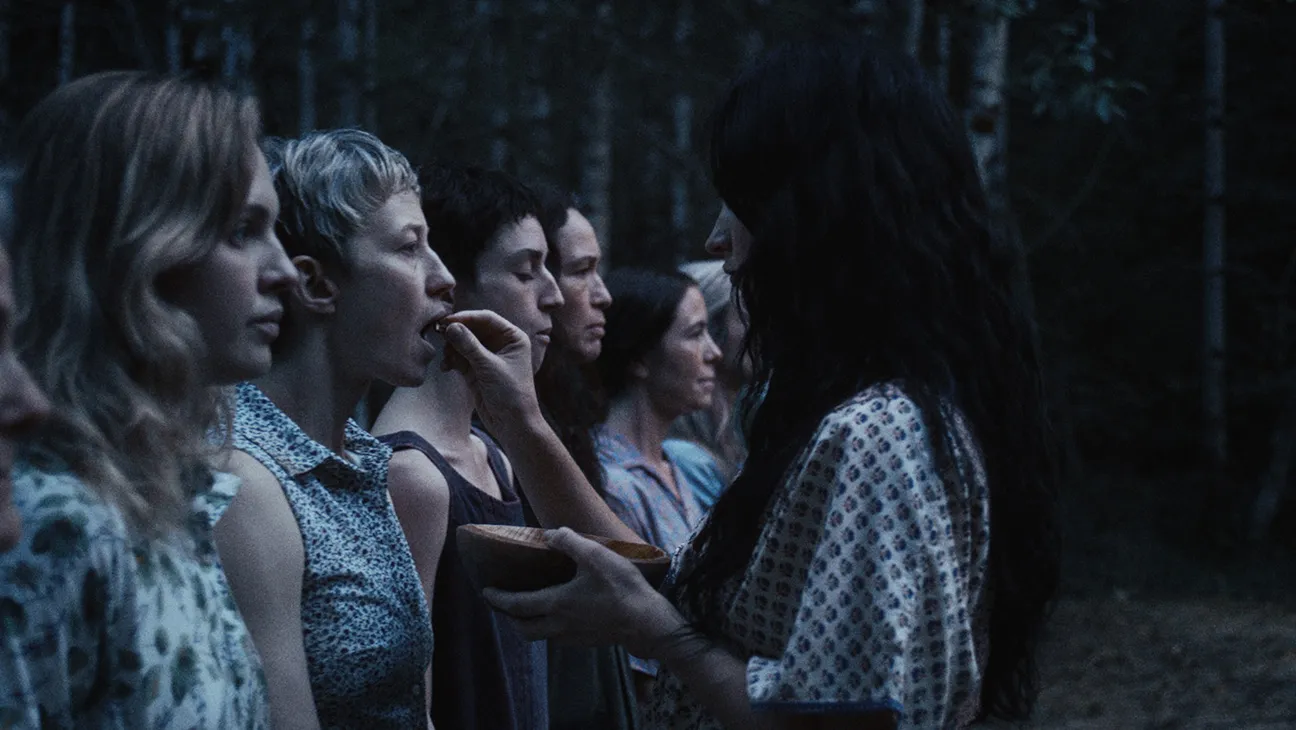
Set in the ’80s, Liberation follows Rita, a Holocaust survivor who is leading an unfulfilling life in suburban New Jersey, where she has a job at a bank and helps to caretake for her aging father, while raising a family of her own. Eventually, she divorces her husband (played by Coon’s real-life partner Tracy Letts) and young adult children (Bella Ramsey and Odessa Young) to join Ricki (Lily James), a charismatic woman who heads up a new-age community of women who practice fasting, take hallucinogens and cut off communication with their loved ones.
When Rita’s daughters follow her to the cult’s compound and attempt to extricate her, she is left to choose between her family and the woman she thinks is the key to her own enlightenment and happiness.
“You see the cliché that only weak people are joining a cult. My grandmother wasn’t weak at all. Anyone who survived the Holocaust and continued life is, for me, a hero,” says the filmmaker, who describes his grandmother as the “pillar” of his family before she left. “I love the fact that my grandmother is depicted as a strong woman who decides to look for happiness. In the ’80s, nobody knew how to deal with Holocaust survivors, so they had to take care of themselves.”
Read more What a Way to Make a Legacy: Cities Declare 9/25 Dolly Parton Day
For her part, Coon, whom Nattiv described as the “Gena Rowlands of our time,” relished the opportunity to play a complex woman that is survived horrible tragedy and seeks something more spiritually fulfilling than the reality that has been laid out for her. “She somehow both recovers her strength of character and also entirely sublimates herself. I just found that tension to be really difficult to understand and pull apart and also deeply, deeply human,” says Coon.
To prepare to play Rita, Coon watched Nattiv’s grandmother’s hours-long testimonial for the Yad Vashem Holocaust Remembrance Center, and listened to hours of testimonials from the Shoah Foundation of other Polish women who survived the Holocaust. The four-time Emmy nominee also watched documentaries about cults, listening to interviews of people who had survived them.
“A lot of them were obviously very intelligent. These are smart people, and what they share is that they are seekers,” says the actress.
And while onscreen stories about cults and cultlike figures litter popular culture, from scripted film and television to the seemingly unending march of streaming documentaries, it is still rare to see a female cult leader, like the one played by James in Liberation. As written by Nattiv and co-writer Noa Berman-Herzberg, Ricki is certainly not a savior, but her aims are also not wholly villainous.
Says Nattiv, “I think that most men that lead cults are only about one thing: Domination. It’s toxic, toxic men who are leading, usually with sexual domination, and there’s nothing really else than that. In the movie, Ricki has liberated Rita. She made her open up. She gave her an added value. So it’s not only bad.”
Coon notes, with a laugh, “If we haven’t seen female cult leaders portrayed in the media, it’s not because they’re not out there. It’s because of all the other problems of representation that happen in film.”
After a decade of trying to get it made, Nattiv, backed by studio Bleecker Street and producers Sight Unseen’s Julia Lebedev and Eddie Vaisman, started filming the story he had spent a lifetime preparing for. Production took place in Vancouver and on Vancouver Island, with the McLean Mill National Historic Site acting as the cult’s compound. Now, as the film finally makes its way to audiences, the director is looking forward to the conversations that the film can inspire around trauma, autonomy and healing.
Coon‘s hope is that, even if the choices made onscreen feel extraordinary, audiences will see there is plenty to relate to in Rita‘s story. “I think it’s really easy for us to stand outside of it and say, ‘There’s no way that would ever happen to me,’” Coon says. “It’s an act of hubris to think that you might not, yourself, be taken in by something. We would do well not to hold ourselves outside of that possibility.”
Read more Charles Barkley Says He’s Retiring Alongside Ernie Johnson After Next NBA Season