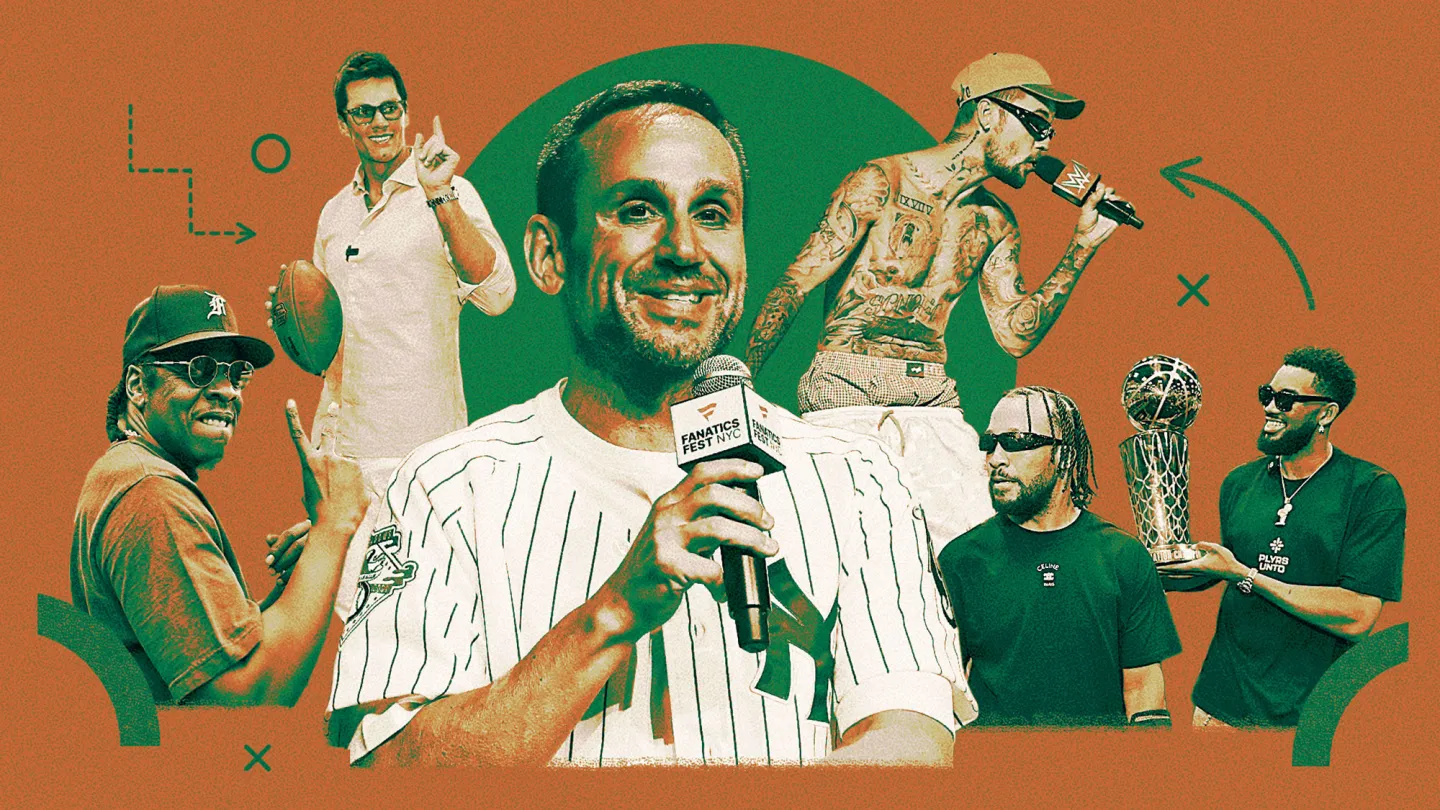
Can Michael Rubin’s Fanatics Become a Hollywood Player?
The biggest sports upset of the year may have come from Justin Bieber.
Days before the music superstar performed at the 2026 FIFA World Cup halftime show, Bieber was a last-minute entrant into the Fanatics Games, an event that pits celebrities like Kevin Hart and DJ Khaled up against athletes like Tom Brady, Novak Djokovic and Victor Wembanyama as well as against 50 regular fans, competing in a bevy of sports-related challenges inside New York’s Jacob Javits Center for a $1 million grand prize provided by Fanatics.
Read more Hollywood Ventures Group Launches Private Global Membership Network Producers365
Bieber wasn’t planning to participate, but after he entered, he dominated the field, beating not only the 50 participating fans, but the athletes too, including Brady, the returning champion. In the FIFA World Cup area, Bieber showed off his soccer skills, scoring as Djokovic and Brady looked on slack jawed.
“I never expected Justin to win the Fanatics games. That was a stunner to me. I still think about that once or twice a day, like, holy fuck,” quips Michael Rubin, the founder and CEO of Fanatics, in an interview with The Hollywood Reporter. “I can’t believe he just came in there … I knew he said he was athletic, but who would have thought?”
Fanatics Games have become a tentpole of Fanatics Fest, the sports company’s flagship experiential event. It’s also become a textbook example of how Fanatics is thinking about the entertainment business: For a long weekend in New York City, the worlds of sports, pop culture and commerce collide, with in-person moments going viral on social (like Bieber handling Djokovic a loss in ping pong), and made-for-TV moments filmed for streaming, be it the ESPN special about Fanatics Fest, or a LeBron James-hosted live podcast taping.
The Games are a live event that people watch in the convention center, and they stream online for fans to follow at home, as clips ricochet across TikTok and Instagram.
“We kill ourselves all year to make that stuff happen, but we think you create a year’s content and you give great stories,” says Rubin.
Fanatics is already a juggernaut. Rubin took an apparel and commerce business and has turned it into arguably the most important sports company outside of media and the leagues themselves. It produces and sells the on-field and on-court uniforms, fan gear, collectibles like Topps trading cards and autographed memorabilia, sports betting and prediction markets, and advertising. But it wants a bigger slice of the media and entertainment business, and that week in New York showed a gameplan for how the company thinks it can win in that space, even without a media rights deal.
Fanatics Fest is the company’s big bet on experiential entertainment, letting fans see superstars like James, Brady, Bieber, Jalen Brunson and John Cena up close and personal.
And earlier this year the company launched Fanatics Studios in partnership with entertainment studio OBB, building out a full slate of programming that it puts on its own platforms, and also sells to partners like ESPN and Fox.
Fanatics Fest served as a production hub over the course of the weekend, with Fanatics Studios staffers shooting video for an ESPN special about the event hosted by Karl Anthony-Towns. Kevin Hart was there taping live episodes of his series Cold As Balls, with athletes like Serena Williams and Rob Gronkowski joining him in the tub for the show. There were a slew of podcast tapings, with James hosting a live edition of Mind the Game, and Brunson and his Knicks teammate Josh Hart hosting an episode of their Roommates Show.
It was in some ways a test run for what the company hopes to do in the content space writ large.
“How do we make this thing sing outside of New York for those that can’t be there?” says Michael D. Ratner, the CEO of both Fanatics Studios and OBB, teasing “a couple substantial announcements in the not-so-distant future” from the studio. “They’re building upon and compounding what we’ve talked about, which is how do we partner and use our storytelling capabilities and our standing in pop culture to work with and affect the most people in sports.”
Fanatics Studios is leaning into the unscripted space with documentaries and docuseries, as well as the event space with the ESPYs, the original event concept Flag Football Classic and other ideas. In July, for example, it set a documentary featuring Olympic gymnast Suni Lee. The idea, Ratner and Rubin say, is to leverage the extensive relationship that Fanatics has with the athletes to get them to play ball, betting that “if we create content that was really strategic to them, we could find different ways to integrate that into our existing business that was great for them and great for us,” Rubin explains.
Or as Ratner puts it: “We’re in business with a lot of the athletes already. We’re in business with a lot of the leagues, and I think that the synergies and ancillary opportunities to the content and storytelling itself is just a unique advantage.”
Athletes, Ratner notes, “are very curated and careful about who they partner with,” and Fanatics has figured it out. So next time a superstar athlete is pursuing a docuseries, or is interested in expanding into entertainment, Fanatics Studios is betting that it can have a leg up.
Those relationships are in many ways the secret sauce that Rubin has concocted. The billionaire (Fanatics is believed to have a valuation in the tens of billions, and has been rumored to be thinking about an IPO in the not-so-distant future) seems to know everyone who’s anyone, inviting them to his famous White Party in the Hamptons each summer, and even more remarkably to the Javits Center for a long weekend.
But Rubin makes the challenge sound easy.
“We try to go through athlete-by-athlete to make sure we create a win-win situation for them to be there,” Rubin says. “We activate a lot of things that are important to them.”
That applies to the entertainment attendees, too.
“I think it’s always about authenticity. Jay Z loves 40/40 [the rapper’s currently closed New York City sports bar], so we pop up a 40/40. That’s super authentic to Jay Z. Jason Sudeikis is super into trading cards, so we’re doing something with him around trading cards. You’ve got Justin [Bieber], who did a pop up across the street for his brand Skylark, but he’s also a super competitive athlete, which stunned me how good he was.
“We don’t ask people to do things, we try to figure out what are they into and we do the things that they are into,” he adds, recalling the moment when Rob Gronkowski sat on a dunk tank filled with Raising Cane’s sauce, only to have Brady nail the target, dunking his former teammate in the delicious dipping sauce. “Think about Gronk’s personality. It makes sense that Gronk would be dunked in Cane’s Sauce.”
And Rubin is the ultimate connector, savvily leveraging the event to bring the most powerful figures in sports, media and entertainment together.
In a quiet corner of the Javits Center, Fanatics reconstructed Jay Z’s 40/40 Club at scale. Inside were giant screens showing the World Cup and other events, a 250-bottle Armand de Brignac champagne tower, and areas for VIPs and celebrities to socialize away from the multitudes of normal people on the other side of the wall (regular attendees would frequently stop and gawk whenever a celebrity stood on the elevated viewing platform overlooking the Fest).
Sports stars, celebrities and business heavyweights could enter from an interior loading dock area to a blue carpet backstage, allowing entry into the club without having to navigate the crowds. The luxury watch brand Audemar Piguet brought Lenny S and his “Gold Standard” couch and photo studio to the carpet, where THR watched VIPs like Jay Z, Shaquille O’Neal and Serena Williams take photos and say hello before heading into the 40/40 Club.
In fact, the club served as a power broker meeting spot on the first day of the event, with Rubin and Relevant Sports Group hosting a lunch with attendees that included media executives like Disney CEO Josh D’Amaro, YouTube CEO Neal Mohan, Netflix chief content officer Bela Bajaria, sports executives like FIFA’s Gianni Infantino, the NBA’s Adam Silver and Patriots owner Robert Kraft, and stars like Travis Scott and Trevor Noah.
For an athlete interested in pursuing more business in entertainment, there was no better place to be.
Walking through the rest of the Javits Center outside of the backstage area and 40/40 club, however, was like having all your senses punched in the face. Eye-popping displays, loud music, and interactive displays were everywhere you turned.
Celebrities (mostly, but not exclusively, athletes) were around every corner.
Wandering the show floor, you might have bumped into Jason Sudeikis or Seth Meyers buying and selling some memorabilia, or Ryan Reynolds negotiating the price of an autographed Hugh Jackman trading card, or Obsession star Inde Navarrette freaking out after being gifted a rare edition of Call of Duty: Modern Warfare 2 by one of the sellers.
It was, to hear Rubin and Ratner explain it, by design.
“You get happy accidents, and you design the schedule so that you get some happy accidents. Some of it’s produced, and when I say produced, that’s not an icky bad word where people should say, ‘oh, that that’s not authentic,’” Ratner says. “Everything there is authentic. It’s all storytelling driven. It’s all about what people are authentically connected to … When you put that many interesting, great people together, you’re going to get stuff that’s just special.”
Read more Scott Rudin Plans Two New Broadway Shows, Including One With Julia Roberts and Paul Rudd
Disney hosted a showcase event on the main stage, where NFL commissioner Roger Goodell joined sports stars like Brady and Gronkowski and Disney characters like Darth Vader and Woody to unveil a new clothing line, as Marvel chief Kevin Feige watched approvingly from the front row, donned in a black Spider-Man baseball cap.
It is a Comic-Con sports fans, and not just because of all the vendors selling merch, and activations on the show floor from the likes of Disney (ESPN), Paramount (for UFC) and the WWE, or the Ryan Reynolds and Kevin Feige appearances.
One way it was decidedly not like Comic-Con, however: After Disney’s presentation, as the audience made their way out, THR watched as Feige weaved effortlessly through a row of sports collectibles sellers, the crowd at Fanatics Fest seemingly unaware that the most powerful man in comic-based entertainment standing next to them. That would never happen in San Diego.
One hurried attendee who brushed past Feige could be heard telling the person next to them that they had to move fast: There was a Logan Paul sighting on the other side of the show floor.
But Rubin and Fanatics ambitions go well beyond one weekend. The Fest was the culmination of a week-long celebration of sports and entertainment, one that took over New York City.
Lincoln Center, in fact, served as the backdrop for Fanatics’ biggest push into entertainment yet.
Fanatics Studios had already produced its first live event, the Flag Football Classic, back in March. But Lincoln Center would be perhaps its biggest test yet. Disney took over the entire plaza and two of its venues for the 2026 ESPYs, ESPN’s annual sports awards show. For the first time, Fanatics Studios was on board as co-producer.
Thunderstorms earlier in the afternoon caused some chaos (the red carpet had to be evacuated), but the elaborate setup around Lincoln Center’s fountain included a bevy of backdrops for photogs to capture, and a performer dressed as the Statue of Liberty was placed near the entrance to the theater, with athletes angling for selfies.
Saturday Night Live’s Marcello Hernandez gamely hosted the evening, with attendees walking across the Center to David Geffen Hall for an after-party that included Katz’s Deli carving stations and elaborate sushi setups.
The ESPYs had not been hosted in New York since 1999, but Rubin says that it was all part of Fanatics’ plan to create the biggest week in sports, kicking off with the ESPYs, and culminating with Fanatics Fest and the FIFA World Cup Final in New Jersey.
“We really created Sports Week, and now everyone’s activating around it,” Rubin says. “You had the WWE come to MSG that weekend, you had with the baseball schedule the Dodgers play the Yankees, you had the ESPYs the night before we kicked off … we like bringing everyone together, and the biggest thing we do is bringing stars there for our fans.”
For Fanatics, the Fest is emerging as a connective tissue of sorts, a real-life space where all of its business lines converge, beyond the entertainment programming. Fanatics-produced collectibles and apparel are everywhere, as are activations for Fanatics Bet, the company’s sports betting platform.
Now the company is finding ways to bring that connection to other places.
Consider LeBron James.
The NBA superstar left the Los Angeles Lakers and jumped to the Philadelphia 76ers. It was a monumental move, one that instantly became the biggest story in sports. So how did it get announced? At 11:30 a.m. on Friday July 24, the news of his move appeared simultaneously in three different places: The X account of Shams Charania, ESPN’s NBA insider, on James’ social media accounts… and on the accounts of Topps, Fanatics’ trading card company, enticing users to purchase a card celebrating his move.
“When you look at the gambling business, the collectibles business, the commerce slash fan gear business, you look at it based on what we can do better for the fan?” says Rubin, contrasting those cores to the nascent media business. “This is really about strategically building our brand and everything we’re doing, whether it’s the Fanatics Flag Football Classic, whether it’s co-producing the ESPYs … they’re all highly strategic to Fanatics, both in the partners we work with and the athletes we work with.”
“I think that there is built-in trust when you have a partnership on the collectible side, or on the commerce side, or at the league level, or with the commissioners of a league, based on these other core businesses that allow us to have a seat at the table to talk about a larger, more in-depth relationship,” adds Ratner. “Whether that’s a doc series, whether that’s a production company partnership, whether that’s a podcast, a video podcast, whether it’s an interview show, there’s built-in inherent trust, and there’s already a formative deal in many of these cases through one of those other businesses.”
The company is ambitious, but it isn’t chaotically so. Rubin has said that Fanatics won’t be competing against the media giants for league sports rights in the near future (longer term, who knows?) and he told a conference during the Fest that there are sports adjacent areas that he just wants to avoid, like ticketing.
But the company still has a big vision for how it can use the scale it does have to grow in the future. The goal, Rubin says, is to create a “sports week” every summer, where all the power players converge on New York City. This year it happened to coincide with the FIFA World Cup final, but in future years the company will try to carve out its own lane.
“How do we keep outdoing ourselves? Rubin wonders out loud, listing all the names they brought to the Javits Center this year, from Lionel Messi to Jay-Z.
“We’ve had different countries offer us hundreds of millions of dollars to bring this to their country,” he said. “We’ve had many of the governors of the biggest states say ‘what can we do to get you to bring it here?’ So long as New York is good to us, I think this is once a year in New York City.”
But the magic is in the talent: When superstar athletes and singers collide with A-list actors and high-profile podcast hosts, the result is more content than anyone can consume, and a brand-builder of a business that is betting it can become Sports Inc.
“You’ve just got to keep pushing the envelope to just create the best environment in the world,” Rubin says. “The second you go back, it’s just not worth doing anymore.”
On Saturday night, after the show floor closed and everyone was packing up, Fanatics employees watched Djokovic and Mike Tyson playing ping-pong. They weren’t ready to leave yet.
And who knows, maybe someday Fanatics fest will become the place to see and be seen for any A-lister. Rubin suggests that it is already on that path.
“When I do the White Party, everyone asks for pictures right away because they want pictures of all the people they were with. They’re the biggest stars in the world, and they always want the pictures from the White Party,” Rubin says. “This year was the first year they were like, ‘give me the pictures from the Fest.’”
This story appears in The Hollywood Reporter’s August 2026 Sports issue. Click here to read more.
Read more German Police Rush to Prevent an Islamic Terror Attack in ‘Blindspot Berlin’ (Exclusive Trailer)

Related Posts
How Pat McAfee Landed His First Acting Role in ‘The Mosquito Bowl’ — With Some Help From Bradley Cooper and Tom Cruise

Jeon Do-yeon Defined an Era of Korean Cinema. With ‘Possible Love,’ She’s Become an Oscar Contender