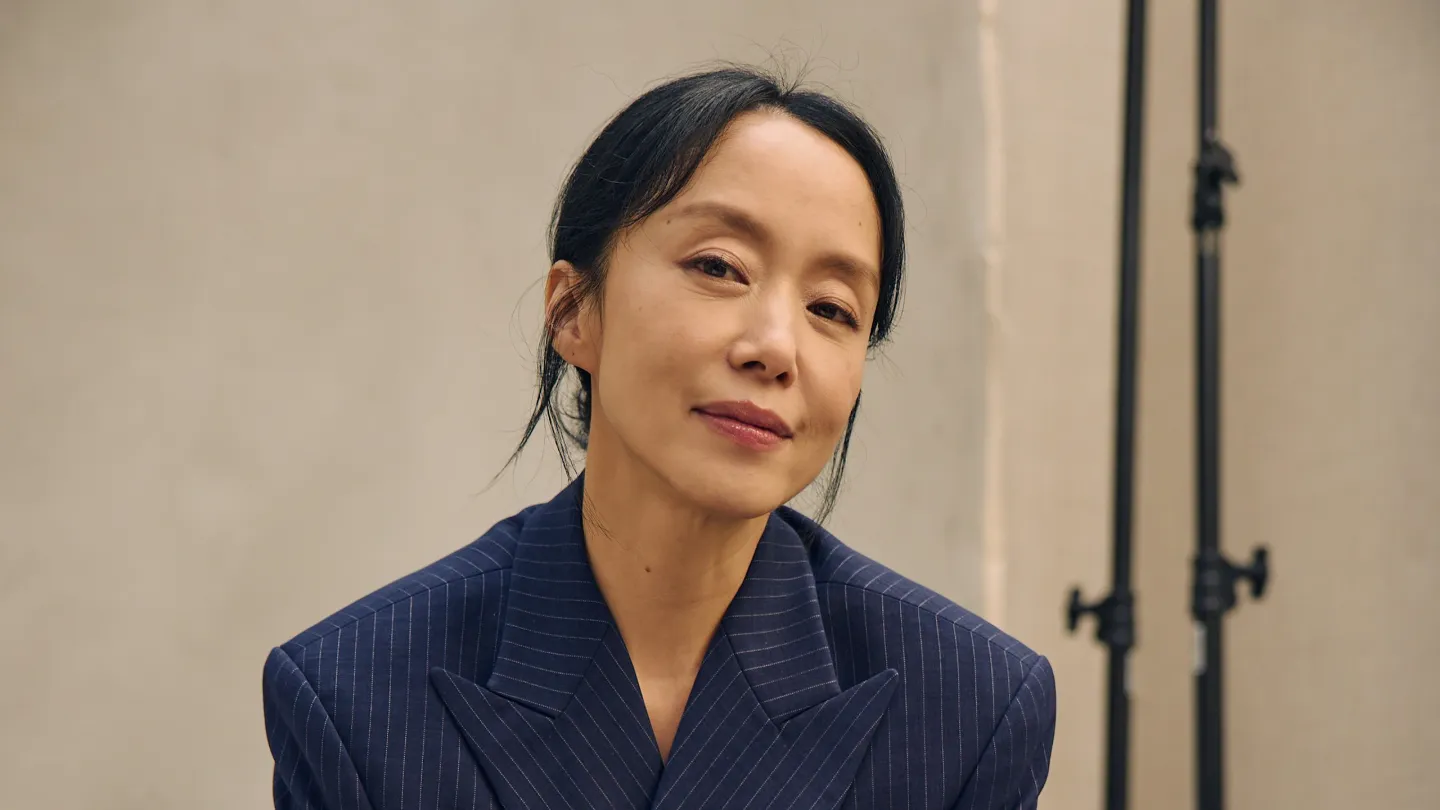
Jeon Do-yeon Defined an Era of Korean Cinema. With ‘Possible Love,’ She’s Become an Oscar Contender
Last year, the veteran Korean star Lee Byung-hun enjoyed his first run on the American film awards circuit, receiving a Golden Globe nomination for his tragicomic tour-de-force in Park Chan-wook’s No Other Choice. He’s now seeing the same thing happen to a frequent co-star of his from back home, in Jeon Do-yeon — a local superstar who’s stirring Oscar buzz as the lead of the rapturously reviewed Possible Love.
Read more Jack Lowden, Margaret Qualley Top Bookie Odds for Next James Bond and Bond Girl
But before No Other Choice, Lee had already been widely known to American audiences via projects like Squid Game and the G.I. Joe movies. Jeon, by contrast, has rarely worked internationally. “In the Korean film industry, she holds a truly unique and unparalleled position,” Lee Byung-hun says. “I almost find myself wondering why it has taken the rest of the world so long to notice her.”
Possible Love director Lee Chang-dong echoes the sentiment: “No one could deny that she is the actress who represents an era in Korea. What is remarkable is that, despite so many achievements, she continues to show new possibilities as an actress.”
Over Zoom on a brisk morning back home in Korea, Jeon has just experienced a whirlwind of a month. Possible Love premiered to raves in Venice, where it won the Grand Jury Prize; the director, Lee, and his cast then traveled to Toronto and New York for the first North American screenings of the movie. The Netflix production, currently in select theaters and set to stream beginning Nov. 6, has cemented its status as one of the major international contenders of the Oscar season — with Jeon, backed by a 30-plus-year career of celebrated performances, emerging as a best-actress player despite a comparative lack of name recognition. Why? Because she’s that good.
“Now that I’m back in Korea, it feels like a dream,” Jeon says of the excitement of Possible Love’s global rollout. “I almost ask myself: Did it all really happen?”
Possible Love takes a searingly intimate look at global labor and inequality crises through the lens of two couples: Mi-ok (Jeon) and Ho-seok (Sul Kyung-gu), struggling to get by after the latter was laid off, and the very wealthy Ye-ji (Cho Yeo-jeong) and Sang-woo (Zo In-sung). An indie filmmaker, Ye-ji is helming a documentary about Ho-seok and his former colleagues, many of whom remain traumatized by their treatment during a mass workers’ strike; she begins interviewing Mi-ok, who is willing and able to go on camera and tell their painful family story, as others decline.
It is hard to imagine anyone else playing Mi-ok. Scene to scene, Jeon makes strikingly humane, unusual choices. Her portrayal is buoyant and curious, both attuned to and alienated from Mi-ok’s hopes and desires, whether emotional or erotic or material. No facial expression or vocal inflection can be read simply; the performance is at its most heartbreaking when at its most joyful. Each person in Possible Love’s nuanced foursome projects onto the rest, yet in Jeon’s dogged empathy, it’s Mi-ok who has set them on a dangerous collision course by the bravura final act.
Jeon felt “apprehensive” about how audiences would react to her vision for the character, filled as it is with lifelike contradictions. But she approached Mi-ok as she’s been approaching her craft her whole career: By investigating herself within the role. “Acting is always going to be this process of finding something within myself that I have, that I wasn’t aware of before,” she says. “Mi-ok is a very strong woman. The way she expresses herself, in that very positive way, is almost her method of maintaining her way of life — and I think I’m pretty much the same way.”
***
Born in Seoul to an “ordinary” family, the 53-year-old Jeon didn’t think much about acting as she started out. She modeled in her 20s after graduating from Seoul Institute of the Arts — her first commercial was for an American company, Johnson & Johnson — and then began taking on smaller TV roles. “I was able to maintain my stamina and strength because, if I had been too desperate or too bent on making something out of myself in the beginning days, I might have burned out [otherwise],” she says. “It allowed me to not completely exhaust myself.”
This included coming up against the pressures and limitations of her industry. Jeon didn’t know at the time, for instance, that there was so much pushback to her feature-film debut in the romantic drama The Contact. “There was a very strong and clear line wherein the film industry tended to really look down on TV,” she says. “I did hear after some time had passed that many people were saying, ‘You can’t cast her because she’s not a film actor.’” She won awards for that performance, though, and stuck around in movies — while also continuing to make TV. She wanted to work and followed the best opportunities, barely aware that she was breaking ground for actresses in the process.
“Films were very quite heavily male-character focused, and so there weren’t as many roles out there for me,” she says. “The reality is that the range was quite narrow for actresses, especially at the time. I focused on choosing the best role that I could.”
This went against the industry standard. But Jeon developed a reputation for vivid performances that changed shape from project to project. “There are very few actors who can immerse themselves in a character as completely,” says Lee Byung-hun, who first acted opposite her in the 1999 romance The Harmonium in My Memory. “She has an incredible natural instinct that allows her to fully embody a character without relying on excessive preparation or calculated choices. Rather than simply portraying someone, she becomes that person.”
Many of these roles saw Jeon summoning an intensity that surprised her only in retrospect. “I was just so focused and concentrated on the role itself,” she says. “Only after time had passed, and through interviews or through other people telling me, did I realize that I took on a number of very challenging roles at the time.” In You Are My Sunshine, which won her first of two Grand Bell Awards (the Korean equivalent of an Oscar) for best actress, Jeon played a former sex worker who tests positive for HIV; 2007’s Secret Sunshine, her first collaboration with Lee Chang-dong, soared off of her visceral take on a young mother going mad with grief.
In most of these cases, Jeon dug deeper into her own psyche. “It was almost as if I was on a journey, searching for new aspects of my own self,” she says. When it came to Secret Sunshine, she felt adrift. She smiles and giggles as she remembers that period — one of many moments in our conversation where she channels the cheery spirit of her Possible Love character, Mi-ok, while reliving tough times.
“I denied or rejected everything that I had to feel in character at the time — I was so full of doubt about everything that I was feeling, and then that process brought about such an intense level of anxiety and pain on my end,” she says of Secret Sunshine. “I was in such a struggle to survive, it was a very painful process. Only after I saw the final film I was able to know who this character really was — what kind of film Director Lee really wanted to make.”
The work, of course, speaks for itself. Jeon recognizes now that her difficulty in accessing the troubled character aided in what was, undeniably, an artistic breakthrough.
“How could a young actress who had never married, and certainly had no children, feel the emotions of a mother who has lost a child?” Lee Chang-dong says. “It must have seemed absurd and baffling to her. Yet, remarkably, she did it. Every day she had to feel emotions that seemed impossible, and when she barely managed it, a harder and more painful emotion awaited her the next day.”
***
Secret Sunshine’s Cannes premiere marked Jeon’s first trip to an international festival. The exposure that followed her triumph on the Croisette was overwhelming and, at times, counterintuitive. She had little experience in action fare, for instance, but started receiving American offers for action movies. “I was getting to audition for smaller roles in these movies, and I was quite perplexed,” she says.
Read more Bravo’s ‘Next Gen’ Goes Franchise With New Atlanta-Based Series
Back home, things were even stranger.
“It had somehow made me a ‘difficult actress,’ so to speak, where within the industry people didn’t feel like I was up for anything, or that I was approachable,” Jeon says. “Many people thought that after Cannes, my house would be filled with scripts and I would be bombarded with offers. But on the contrary, in fact, it was the time in my career where I had the least amount of offers and scripts coming in, and I struggled quite a bit. I had to accept that. I remember thinking, ‘What do I do now? How do I free myself from the weight of the award?’”
Her first movie post-Secret Sunshine was My Dear Enemy, a moving slice-of-life following two ex-lovers driving around Seoul. “While it was small, it was a great film,” Jeon says. Yet press coverage around her involvement was brutal. As she sums it up: “Why would Jeon Do-yeon pick that one after she won in Cannes? Why did she choose such a small film?”
Her second movie post-Secret Sunshine was The Housemaid, a divisive revenge drama heavy on graphic nudity. Jeon gave birth just before filming commenced and felt concerned about what the movie would require of her. Yet true to her reputation, she threw herself into the material with a fearless performance, undeterred by how any audience member might react.
“It was an opportunity to accept a new part of myself as an actress — it wasn’t just about my face as an actor. I am an actor from head to toe, and if needed, I should be ready,” she says. “It liberated me in a way that I hadn’t experienced before.”
By this point, Jeon had played a number of rich, distinctive roles on screens big and small. Her choice to stay focused on expanding her filmography in Korea proved particularly bold given the realities for actresses in the industry as they aged out of ingénue status. “Compared to the United States, Korea is an even more conservative society — we are hypersensitive to age and looks, especially when it comes to actresses,” she says. She has continued to break barriers by defying that conventional wisdom and pursuing ambitious work.
“I am doing my part to expand that range on my own, and it may not be something that people are aware of,” Jeon says. “However, I know for sure that when it comes to myself, I try to always push the boundaries, always make sure that I break out of my own shell. That I reach for and expand my own horizons.”
Lee Chang-dong adds, “[She] did not settle…. She kept challenging and fighting as an actress.”
Just a few years ago, she starred in the rom-com series Crash Course in Romance, with Jung Kyung-ho, who is 10 years her junior, portraying her love interest. The local press was aghast: “There would be headlines all over the place with my age in it, or saying, ‘Is it even possible for an actress of this age to be the lead of a rom-com drama series?’” she says. “I didn’t give it a second thought.” Sure enough, the show was a smash hit, with Jeon’s character’s fashion even inspiring shopping trends. According to one retailer, the flower-patterned blouse she wears in the show led to increased sales of various retro pieces in the range of 60-90 percent.
The coverage then turned to headlines like: “Jeon Do-yeon did it again — despite her age!” She says now with a smirk, “I didn’t feel like those were real compliments.”
Then there is the case of Simon Stone’s hit stage revival of The Cherry Orchard, with which Jeon has traveled from Hong Kong to Singapore to, earlier this fall, New York. The roving production starring a Korean cast has been a passion project for Stone, a revered theater director who’s also the filmmaker behind another 2026 Oscar contender, Elsinore. Jeon’s casting proved the key to the puzzle.
“It was obvious we were going to need an extraordinary actress in the lead. I said to the team, ‘Who’s the Meryl Streep of Korea?’ and their answer was Jeon Do-yeon,” Stone says. “Scenes become hilarious that were just heartbreaking a moment before. There’s a mercurial quality [to her] that is deeply intriguing.”
All told, over decades, Jeon has built a defiant career in terms of both its consistency and versatility. And all of these experiences led to Possible Love, which Lee Chang-dong knew would feature her from the moment he had the initial seed of the idea, more than a decade ago. It’s the kind of star turn that reveals its actor’s history across every frame, the apex of a rivetingly complex life lived onscreen.
She has grown a great deal since her trials on Secret Sunshine, and with her Possible Love spouse, Sul Kyung-gu, again has years of working together to work opposite. “We’re also very close friends in real life too, to the point where we feel safe to bring that actual energy to the screen,” Sul says of his dynamic with Jeon in Possible Love. “I was just so grateful to have her as my partner.”
At 100 percent on Rotten Tomatoes as of release day, Possible Love has reached a level of acclaim that places Jeon into legitimate Oscar contention — another first for her. She has heard the chatter. She’s seen the headlines at home speculating about her chances. And she is letting it all wash over her. “That has never been my goal,” she says. “That has never been something that I coveted.”
Worth noting, though: If the Academy recognizes her, Jeon would be the first person ever from South Korea to be nominated for best actress.
“It is still very rare and difficult for an actor in a non-English-language film to be nominated for an Oscar, [and] I believe her performance, which brings such complex, layered emotions to life, can capture audiences’ hearts across language barriers,” Lee Chang-dong says. “Proper recognition from the Academy…would be both a recognition of one actress’s achievement and tangible evidence of the change the Academy is striving for.”
Regardless of where it leads, Possible Love has felt like a kind of culmination point for Jeon — for a career that started out slow and unsure, and that has been continually defined by defying the odds. “I have gained all that I had ever wanted to gain as an actress through Possible Love, and it has allowed me to really feel confident in the journey that I chose for myself,” Jeon says. “It has given me a certain level of strength that I think will carry me through the upcoming years. I feel like I am going down the right path.”