‘14th’ Review: Ava DuVernay Delivers Another Essential and Compelling Constitutional Deep Dive for Netflix
On November 3, U.S. voters will cast ballots in midterm elections that will go a long way toward shaping or reshaping our government. The results will offer a pivotal snapshot of how the country is currently viewing the solvency of our particular brand of democracy.
Read more BlumFest Haunts New York Comic Con 2026: All the Highlights From Blumhouse Atomic Monster
Ava DuVernay‘s new documentary for Netflix focuses on the 14th Amendment to the Constitution, recent attempts to strip the 14th Amendment of its power, and the ways in which the 14th Amendment embodies and represents the ideals and long-term viability of the American experiment.
14th
Infuriating and inspiring in the right ways.
Release date: November 27 (theatrical); December 4 (Netflix)
Director: Ava DuVernay
1 hour 48 minutes
Naturally, Netflix has set 14th for a brief theatrical run on November 27 ahead of a streaming premiere on December 4th. A sequel or companion to DuVernay’s Oscar-nominated 13th, the doc is a cogent, urgent clarion call, and Netflix is sending it straight to the scheduling equivalent of voicemail.
I’m baffled, but I guess it isn’t my job to review programming choices or corporate politics. Like its predecessor — I briefly was outraged recalling that 13th lost the Oscar, until I was reminded that OJ: Made in America won — 14th is powered by well-earned rage; also like its predecessor, it’s more a history lesson and a model of carefully composed rhetoric than a screed.
As anybody who studied Constitutional amendments in school — and why isn’t that everybody? — knows, there are plenty of amendments that can be summed up in a catchy phrase: “Alcohol? No!” “Actually, alcohol? Sure!” “Vote at 18!” “Vote if you’re a woman!” “Cruel and unusual punishment, like when a state is unable to correctly administer the death penalty (or, actually, the death penalty itself)? No!” Etc., etc.
DuVernay’s last documentary focused on the supposed simplicity of the 13th Amendment, which outlawed slavery and involuntary servitude, except in cases where the prison industrial complex is involved. It’s a simple amendment, but the hypocrisy around its implementation remains complicated.
The 14th Amendment is not one of the simple ones.
As Stacey Abrams, part of a wide-ranging group of talking heads here, puts it, the 14th Amendment is the “everything bagel” of constitutional amendments.
As Dr. Eric Foner puts it, the 14th Amendment is the most important since the Bill of Rights.
As Dr. Sherrilyn Ifill explains in some depth, the 13th, 14th and 15th amendments reflect a grand reimagining of the American experiment in the aftermath of the Civil War — almost a second Constitution.
The amendment offers a new definition for citizenship, one built on equality, particularly in issues of due process and equal protection under the law. It’s the foundation for Supreme Court decisions allowing for interracial and gay marriage, the origin of birthright citizenship, and the reason why paying off the January 6th insurrectionists is blatantly unconstitutional.
It is, in modern TV and movie terms, a constitutional reboot, and like so many reboots, it has sparked debate about what is and isn’t canonical to the intention of its framers — both the original constitutional framers and the framers of these bridge amendments, including John Bingham, Thaddeus Stevens and Charles Sumner. Note that the documentary promises to remove the obscurity around this second group of framers and, unfortunately, it doesn’t come close.
DuVernay and her various talking heads establish quickly why the 14th Amendment is so essential, and then go into depth on the attempts to erase the amendment’s protections over the years, with a particular focus on the decades of efforts to erase the immediate gains of Reconstruction. Some of that will be familiar to regular viewers of documentary and comedy/news programs, especially when it comes to the evisceration of the Daughters of the Confederacy, the perpetuation of the Lost Cause myth, and the erection of countless monuments to the various slaveholders and insurrectionists who fought for the South. I attended a Jefferson Davis Elementary School in my youth — since renamed for Barack Obama — so much of this hit hard and close to home.
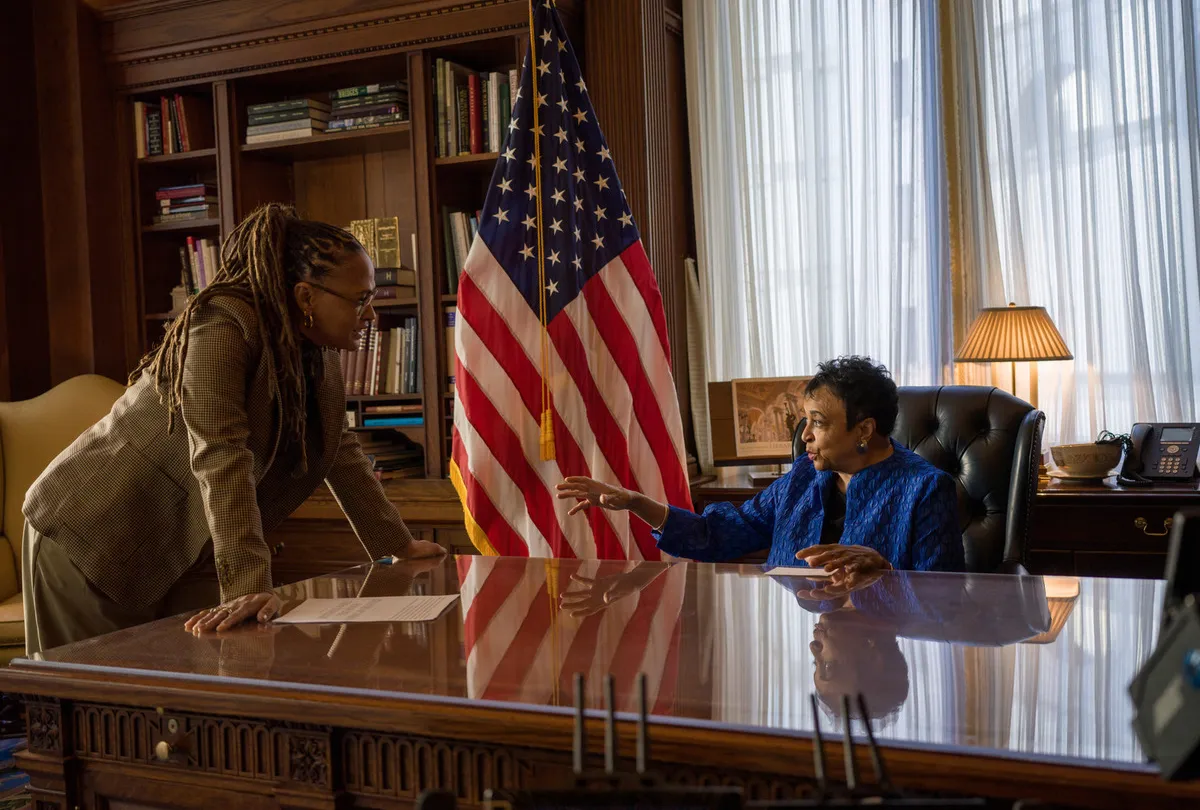
In addition to the usual historians, constitutional scholars, populist commentators and politicians — including Alexandria Ocasio-Cortez, Jasmine Crockett, Alex Padilla and dedicated regurgitator of MAGA talking points Anna Paulina Luna — DuVernay weaves in ground-level vignettes. We spend time with the likes of Devon Henry, the contractor tasked with removing Richmond’s Confederate monuments, and Dr. Carla Hayden, fired as the Librarian of Congress for poorly articulated reasons related to the current administration’s war on DEI.
The documentary is fairly straightforward, but never visually dull. DuVernay stages her interviews in a diverse assortment of settings, moving the camera in a way that’s kinetic but never nauseating. There’s a frequently utilized effect that brings to life vintage black-and-white photos, which comes across as an extension of Ken Burns’ beloved technique with a computer-effects twist that I don’t fully understand, but it keeps things lively. The argument DuVernay builds is deftly constructed within the 108 minutes of the documentary, escalating from past to present to future and from dryly historical to emotional and visceral.
Spencer Averick’s editing and the score by Jason Moran retain a high intensity throughout, evoking a heist movie in which the main antagonists are out to steal your rights. Which is apt, I guess.
The documentary generates anger, sadness and even, by showcasing clips from the likes of George Carlin and Hasan Minhaj, humor. More than that, though, 14th made me wish for two things: First, that DuVernay continue her amendment-by-amendment documentary series until we eventually get her exposé on the timetable of Congressional salary increases. Second, that given the effort DuVernay puts into these films, it would be nice if they were released at the time when they could most successfully stir people to action.
Read more Iliza Shlesinger and Mira Sorvino to Receive Top Honors at San Diego International Film Festival

Related Posts
Israeli Americans Protest ‘NAZA’ Los Angeles Screening as Doc Releases Theatrically in U.S.
Roseanne Barr’s Self-Produced TV Series Now Courting Distributors, Co-Creator Says