“I’ve Disobeyed the Film God Laws”: Lindsey Ryan on Shooting Her Debut Feature at Sea, With Kids, a Boat and a Hamster
When Lindsey Ryan showed producers an early draft of her script for Capsized, everyone was in agreement: She must be insane.
Read more ‘Heated Rivalry,’ ‘Hacks’ Top GALECA Dorian TV Awards Winners List
“And it’s true,” the American director laughs over Zoom in late July. We’re catching up ahead of the world premiere of her debut feature film at one of Britain’s most prestigious film festivals in Edinburgh. The weight of taking a competition title to the Scottish capital is not lost on her, even if she admits the high-risk (and high-reward) project was quite the feat. “I literally did all the things you’re not supposed to do,” she continues. “It’s almost a cliché to say that. But I had an animal. I had children. I had a boat. I’ve disobeyed the Film God laws.”
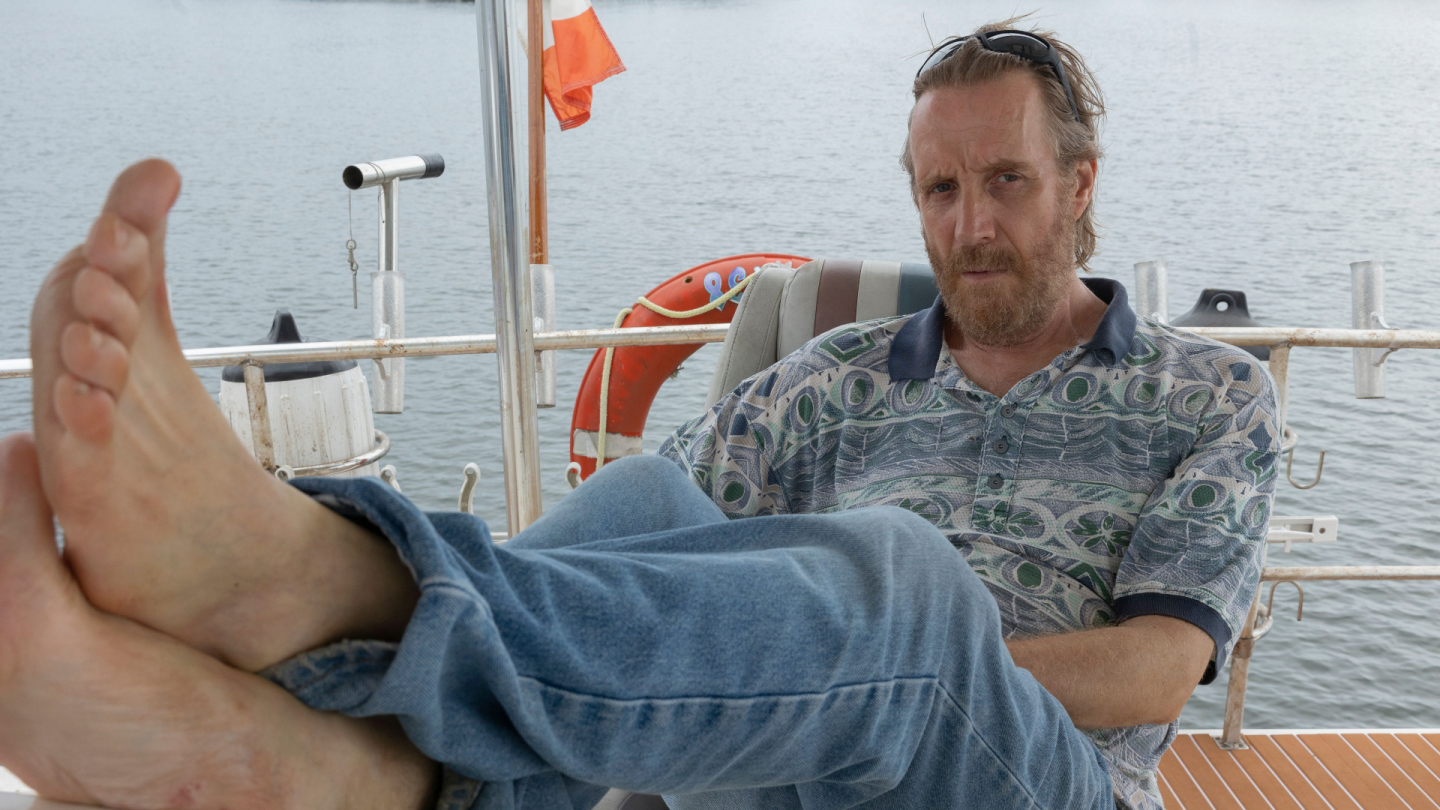
If anything, the Film Gods were totally rooting for Ryan and Capsized. It follows an idyllic houseboat trip thrown into disarray when Diane (Lily Rabe) and her five children (Sarah Catherine Hook of The White Lotus fame, Griffin Gluck, Eli D Goss, Ada Bland and Joan Stein) are rocked by revelations of financial strife kept secret by the at times charming, mostly chaotic family patriarch, Ray (Rhys Ifans). At sea and with a choppy holiday ahead of them, they face a struggle to stay afloat, emotionally and financially — but not before competing in an epic fishing competition.
Shot on a real boat out at sea, with the children contracted for no more than four hours of filming a day and a dangerously small hamster on deck, some filmmakers might have been a little daunted by what Ryan and her crew were attempting to do. (It certainly didn’t help that the Coast Guard was keeping a keen eye on their every move.) But if anyone was to pull it off, Ryan — who grew up in Long Island and could drive a boat before she could drive a car — would have been the safest bet. “I have accidentally become the expert boat filmmaker,” she tells THR, listing Jaws and Gilligan’s Island among some of her maritime inspirations. “The sea theme is very prevalent in my life — I’m just always called to it. I think that the world is so enchanting. It’s totally an obsession.”
Capsized is an American indie humming with humor, heart and nuance — so richly textured you can almost taste the sea salt — and, as it just so happens, fits perfectly with Edinburgh’s reputation for finding fresh, inventive voices. Below, Ryan talks about luring Ifans and Rabe on board, why her antagonist captures such a specific subset of American culture, and how the current state of the U.S. film industry gives way to some bananas, outside-the-box filmmaking: “We want stories that are fresh again… and I think that where there’s a will, there’s a way.”
Your last film, a short called Seasick, is also set on board a boat. Do you have a personal attachment to this setting? Did you grow up on the coast?
Yeah. It’s funny. I have accidentally become the expert boat filmmaker. (Laughs.) Even [in] my early work, when I was experimenting and when I got my first camera, every piece I’ve ever made is on a boat in the middle of the ocean and every single time I do it, it’s insane. Why don’t I just try something on land? (Laughs.) And then somehow I find myself on a boat again.
But I grew up in a big fishing family and where I’m from in Long Island, just outside of the city, it’s called the South Shore of Long Island. So I grew up always being on the sea, always being on a boat. I was a deckhand in one of my earlier jobs. So the sea theme is very prevalent in my life, for sure. I’m working on this other big project that, of course, is seafaring the Atlantic coast. A crazy story. That’s big and exciting, but I love anything with the ocean and maritime themes.
Do you think you’ll keep that as a running theme through your filmography now?
I do. I’m just always called to it. I think that the world is so enchanting. It’s an obsession. It’s totally an obsession. There are ideas for me that are outside of the seafaring, maritime setting, but any time [something on the sea] comes up, it’s always a project that feels so near and dear. But I love movies that have these really unique backdrops and then you get to explore characters. It often ends up being a maritime thing for me, but I also love a desert landscape. Really unique environmental geographies are what I’m drawn to for sure, and water probably being the north star of it all.
When you were honing your craft and working towards becoming a filmmaker, who or what projects were formative for you in this genre?
My most obvious is Jaws. That movie, for me, is perfection. I love Jaws with such a passion. It’s terrifying, and I just remember being so gripped. [I remember] watching that movie young, being terrified of the water from that moment after, and just falling in love with the textures of that too — a seaside community, interesting characters. That’s everything: getting to meet the wacky characters of a place. I’m trying to think of another. [Mutiny on the Bounty] I really loved. Marlon Brando did something so interesting in that movie, and I remember feeling like his performance was a new wave of performance for actors. He brought this contemporary thing to this otherwise very theatrical film. This is gonna be such a crazy answer, but Gilligan’s Island. I continuously go back to the colors of that, the way that it feels campy and nostalgic and trapped on an island. So [I’m] definitely influenced by the major nautical movies and all this early Spielberg stuff for me.
It must pose quite the logistical headache, filming on a boat. Is your job made more practically difficult?
I mean, I learned to drive a boat before I could drive a car. I’m fortunate that people in my life had boats and [I’m] able to tell where I am because I know what buoy I’m off of. I speak the language of the water in such an interesting way, and there’s no doubt that that has been an extreme benefit in shooting out at sea. Because I’m super familiar with what it’s going to take. But it does pose an interesting challenge because then you find yourself the expert amongst your film crew, and you’re trying to direct and have your creative necessities. But then with Capsized, we had a marine coordinator, and they were a good partner, but even still, their experience lacked on the filmmaking front. So there’s this interesting gap that I kept finding myself filling of like, “Oh guys, we can’t run this scene because the water’s shallow right here. So we have two minutes of time before we’re running aground.”
There are just things that you need to know about boats, and I feel like you could apply that logic across any obscure craft or hobby. Like even with a familiarity of boats, the challenges that come within the environment being ever-changing is really difficult — add kids and an ensemble cast to that and it’s next-level challenging.
And in Capsized, this were no effects or anything. You filmed aboard the boat the whole time?
The whole thing was practically shot, which was pretty big for a first-time filmmaker — to be pushing the practical shooting of it all. I had the greatest producing team on this film, Paul Mezey and Sam Scolarici, Dan Janvey and our other producers [too]. But Paul and Sam were the best duo in letting me have the craziest thought and being like, “Okay, well let’s see how close we can get to actually what is in this crazy person’s mind.” And for me, you can’t capture the sea. The way that the sun hits the side of your boat and creates a harsh sunlight, the way that it glimmers on the water… There’s so much about that experience and the textures of that are so important to me.
When did you know this story was going to be your first feature film?
I just was like, “Of course I have to make this movie.” I’ve known people that have these houseboats, and Long Island is such a specific place. The patriarchy is very strong out here in a very interesting way, [and] you can observe it in one of three marriages. It’s like an old piece of society’s fabric that maybe just continues to carry through very strongly in Long Island. I just became obsessed with this idea of these women sustaining these insane behaviors, especially of the fishermen, that rough, gruff type. What really got under my skin was just watching all of these women battle these battles and the feminine perspective on what it is to realize that you don’t have to [put up with] that. The setting of being on a boat and what that does to a family dysfunction story… I liked the idea of not letting them run any further because you’re literally trapped on the last phase of this journey together.
Well, one of my questions is about Rhys’ character and his marriage to Lily’s. He’s completely dismissive of her, but there’s this odd debt of gratitude she feels she owes him. There’s an emotional trapping just as much as a physical one.
Yeah, and the cost of organizing around one person’s gravity. I think that dynamic is transferable across so many things. Friendships have this in an interesting way — maybe there’s that one person in a friendship group [who] can just control everyone in the room because you know you’re avoiding the fight, or you don’t want to deal with that person’s psyche a bit.
Lily Rabe and Rhys Ifans do such an incredible job. They’re both such amazing actors. The way that they respond to each other and the way that Diane slowly has this metamorphosis, by way of her daughter helping her get there… And parenting your parent, that was a big theme for me too. Like, when you become an adult, it’s the first time you see your parent as an adult, and what does that look like? What does it look like when you realize, “Oh, my parent is a flawed person and I never realized it.” How does that shape you?
And Ray is the antagonist of this film, but I suppose the thing with these men is they are also charming and charismatic. By the end, is he a man beyond redemption? Maybe not. How did you want to frame that?
That’s a very keen observation because that’s exactly what I intended. That was a really, really tricky thing to to navigate too because you’re constantly calibrating so many of the characters, and when you have an antagonist, finding that balance of when are we enjoying him and when are we just withstanding him [is difficult]. It was about finding these moments, like when Ray is doing the Ray thing and he found them a way to be at this beautiful yacht club and enjoy this vacation, and then in the same day he blows it all up and they have to go. Ray is his own worst enemy in every situation. And I think that the duality of this movie is it’s not black and white. He’s not all good and he’s not all bad, and I think that like you can feel that thread in every interaction with Ray. You’re just getting to root for him, and then he does the Ray thing, and you’re like, “Jeez, Louise, come on!”
Such a testament to Rhys’ performance too. How did you gather such a wonderful cast, and how can that propel a debut filmmaker?
We were really, really lucky to have an amazing casting director, Susan Shopmaker, and my creative producing partner, Sam. We’re together in life too, so it’s a great balance: Her brain understands my brain so so so deeply. I think we had seen Rhys in a few things. We just felt he had this ability to be so charming, and then turn on a dime. And there was something so alive about everything that he does as an actor. Because Ray could be very one note in the wrong hands, and I think Rhys’s ability to just be so complex is what immediately [made us think] he’s our guy and we were really hopeful that he connected with the script, because not everyone wants to play the bad guy. He made a brave choice in doing that and did truly amazing work. Like, he is Welsh. He does an incredible American accent. He sounds exactly like this part of Long Island.
Lily Rabe, I have been a fan of [hers] for so long. She carries so much pathos in her performances. She can give a look that just says everything, and I was super interested in that because Diane is a character who’s been quieted. Diane is a character who’s been tucked away. She’s tucked away her own needs for everyone else around her, and I think Lily has this ability to just compartmentalize a performance, and then find a strength unlike any other. I just knew Lily was going to be the person who can, again, navigate those different hemispheres of the character, and I thought together they would just be electric with their theater backgrounds. And, surely, they were.
It must have been pretty tricky filming with the kids. A lot of health and safety forms filled out…
It was hard. It’s funny because when we were getting the script in front of people in the early stages, people were like, “Oh, this is actually insane. You’re crazy.” (Laughs.) And it’s true. I literally did all the things you’re not supposed to do, and it’s almost a cliché to say that. But I had an animal. I had children. I had a boat. I’ve disobeyed the Film God laws. What was really challenging is we can only have the kids for four hours a day, and the kids were almost in every single scene. And the boat we shot practically. There’s no removable walls, so it was a real challenge [of] how do we connect the geography of the space when I’m missing half my cast. You have to get inventive.
And then add in the complication of you’re in the middle of the ocean and it takes 40 minutes to get to shore. Like, we can’t be dropping them off. It was very, very, very tricky. And our AD department did such a great job of coordinating… It was puzzle-piece configuring and it was crazy, but I do think it created an interesting rhythm for the movie that made it fun and exciting. That challenge kept everybody on their toes a bit and as crazy as that sounds, I would do it again.
I can’t even fathom how much work went into that. I think that energy does translate, and for all of Ray’s flaws, this is an optimistic film. Were you trying to depict a different side to America?
It’s interesting because Ray’s character is [representative] of such a subculture in America. I think [the film] comments on the financial insecurity and he’s almost a caricature of this type of man in the States. Again, I’ve known so many of these men that’s why he wears the costume for all of them. And in Ray’s optimism is also a big part of the reason why he’s so problematic. So it’s a tough question to answer on that front, just because I feel like American politics right now is such a disaster. I’m an innately optimistic person, and I think that Ray doesn’t necessarily learn the lesson that I think we, as a society, in the States, need to learn — which is [that] money is not necessarily everything. I think that Ray still being on the boat at the end is almost this stubborn ideal.
Edinburgh is such a brilliant vehicle for emerging filmmakers. Have you been before? Are you excited?
I feel so grateful. In a world where we’re all competing for our movies to be seen and made and heard and watched, it is such an immense honor because I’m a huge fan of the kind of movies that get programmed at Edinburgh historically, and I think this year’s lineup looks unbelievably strong — which I’m nervous about — and it’s of course nerve-wracking to premiere a film like this in the U.K. I’m curious about the reception of it because of the way it captures America. It’s a very American indie, in a lot of ways.
Do you feel optimistic about the future of independent film in the States?
I do. It’s very difficult right now because we’re undergoing a massive transformation in independent cinema. I think that’s where the growing pains are coming from. I think everybody’s responding to something that’s changing in real time under our feet, and it’s hard to get ahead of something when nobody knows which direction is up. Nobody knows what’s unfolding right now, and I think that can lead to a lot of pessimism and frustration and confusion, which I definitely feel. There needs to be some significant change in how we get independent films out there and how we can get audiences. Because I think the distribution pipeline is really, really broken, and the festivals give us all the shot to get there. But even that is getting really hard… And how do you, as a society, sift through so many talented voices?
I still feel super optimistic about independent film. What’s going on with Backrooms and Obsession, I know everybody’s pointing to that, and I think it’s just a good case of we want stories that are fresh again. I’m not saying let’s go make a bunch of horrors because I think that’s the obvious next step. (Laughs.) The industry goes straight to trying to do the same thing and falls back into that same trap. But we’re entering what feels like a golden age and although it could be really hard to raise funds and find partners and stakeholders that really believe in you, I think that where there’s a will, there’s a way. People still want to make art and people still want to be a part of something — now more than ever — that can communicate something to society, to people, to audiences. We’re hungry to feel seen again.
This interview has been shortened and edited for clarity. The 2026 Edinburgh International Film Festival runs Aug. 13-19.
Read more Adam Scott Says Daughter Had to Watch His ‘Office’ Audition Tape in Acting Class: “What Not to Do”