‘Manhunt’ Director Says His Haunting Exploration of Alienation, Masculinity Is “a Film About Fascism”
Michif filmmaker Wayne Wapeemukwa isn’t afraid to use visceral visuals and sound to question the world we’ve built, training his spotlight on those pushed to society’s margins.
Read more George R.R. Martin Says He Battled Depression This Year: “The Worst May Be Yet to Come”
His debut feature, Luk’Luk’I, followed five residents of Vancouver’s poverty-stricken Downtown Eastside during the 2010 Winter Olympics, with a screenplay the Canadian writer-director developed alongside his actors. The film won best Canadian feature at the Toronto International Film Festival in 2017, and Wapeemukwa took home the Directors Guild of Canada’s DGC Discovery Award.
This week, he opens the international competition at the 79th edition of the Locarno Film Festival with his sophomore feature, Manhunt — a mesmerizing, unsettling journey into social and psychological terrain that’s likely to shake viewers to the core.
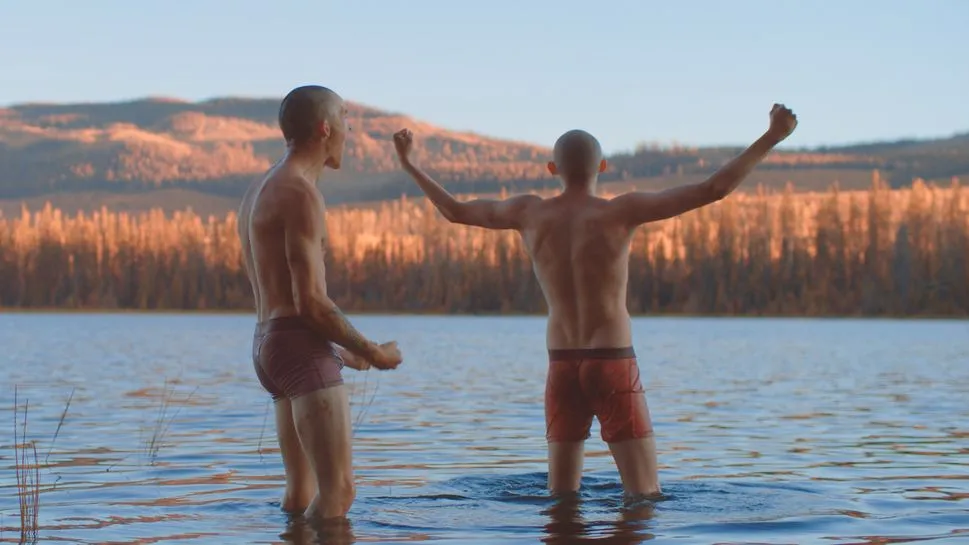
Inspired by real-life murders in Canada in 2019, the film follows two young men on a road trip through the country’s northern frontier, fleeing their dead-end lives. Rather than reconstruct the facts behind the killing spree, Manhunt asks harder questions — about disconnection, alienation, modern masculinity, far-right and digital fantasies, and colonial echoes — to probe where such violence actually comes from.
As the two men drive through empty towns and vast forests, their lives dissolve between digital fantasy and offline reality. The Locarno website teases what’s ahead: “Reframing true crime as a parable, Manhunt probes loneliness, masculinity and the colonial dream of beginning anew — until the search for meaning erupts into violence.” Or, as the press notes put it more bluntly: “Two boys discover they can’t outrun what they’ve become.”
Sorrow curdles into hatred; the longing for connection turns violent. In the end, the two men find not salvation, but the barren land inside themselves.
Manhunt, which Wapeemukwa wrote with Anna-Lena Theobald, stars Harris Lowe, Landon Tunold, Bianca Foscht and Dilara Foscht, with cinematography by Jonathan Glendon and editing by Coline Debray. Wapeemukwa produced alongside Nathan Drillot and Matt Drake. Vaka Street Casting — also behind the Canadian hit Blue Heron — handled casting. Cinetic Media acquired North American sales rights, while Aspect Ratio is handling international sales.
Locarno artistic director Giona A. Nazzaro, in a recent interview with THR, praised Manhunt as a film that “questions the colonial myth of what is beyond the frontier and how this myth still affects people.”
Ahead of the film’s Locarno premiere, Wapeemukwa spoke with THR about his deep dive into human emptiness, darkness and fascism, how his Michif heritage shapes his thinking on disconnection from land, and his growing interest in genre work.
Manhunt is inspired by Northern British Columbia murders in July 2019. Why did you want to make a film about them and why in the specific way you chose, which is very different from traditional true crime narratives?
At the same time as the actual events that unfolded in 2019, I was road tripping through my indigenous homeland. My dad’s white, and my mom is Michif, and so I was going through places in Saskatchewan and Manitoba, while watching this unfold at the same time in cafes and bars and whatever. I guess I was meditating a lot at the time about themes similar to my first feature — about how our attention in society is diverted away from certain problems and towards other kinds of low-hanging fruit.
So, I was meditating on these events with these two young boys and why our society focuses so heavily on this sort of violence, which is terrible. I do not want to diminish the significance of this at all in any way, shape, or form, but it’s interesting to me that our attention, especially in Canada, so gravitates towards that spectacle versus the ongoing femicide of Indigenous women, for example.
Why do you think that is?
That’s a very complicated question. … If the question is why do we block out an understanding of that versus other narratives, why is our attention so misdirected, I think there are a lot of reasons for that. Fundamentally, it’s to do with the fact that our society in Canada persists because of that ignorance. If that ignorance was really confronted in what it really meant, Canada as a country, as an idea, would become intolerable.
The press notes for Manhunt mention that you feel that there is a lack of connection to land that is one of the drivers behind the two young men we follow in the movie. Is that something you thought about as a Michif filmmaker or where does this idea come from?
In my research for this film, which took place over seven years, I was talking about it with elders in my community and getting their take. And one of the elders mentioned to me that when she thinks about these boys, she thinks about how they have no connection to land, and that doesn’t just mean some sort of blood and soil connection. Indigenous peoples generally understand connection to land in much broader normative terms, and what I understood her to be actually saying was: “These young men are disconnected from community.”
It’s about a communal way of relating with each other and relating to the environment and where we are from. In my subsequent empirical research about these boys that the 2019 story is animated around, I couldn’t see anything otherwise. They worked at Walmart; they were disconnected; there were lots of social pressures on them. Society disconnected them through poverty, etc. And as I researched other mass murderers and white supremacists, I found that this was actually a lot more common than I had first anticipated.
Do you think of Manhunt as a timely universal tale more than a specific Canadian story?
I consider it as a sort of parallax, as both. There’s a similarity with my first feature as well. It is a story that’s super localized and grounded, but at the same time is stretching at least for a global and especially an international audience. This is a reason why I feel so privileged to be invited to open the competition at Locarno. This was a film that I intended from the very beginning to reach beyond Canada.
Oftentimes, I find that Canadian cinema is provincialized and sequestered, but I wanted to do something beyond that, and, unfortunately, the topic of white supremacy is especially international.
Can you maybe share some more of your thoughts on that?
It really seems like the Nazis are back, and I do not say that enthusiastically in any way, shape, or form. And this film effectively became something about that. The film is its own fictional portrayal of the actual 2019 story, right? It became, for me, a film about fascism and also, because of my politics, anti-fascism. What we’re witnessing here in my movie is a homegrown form of Canadian National Socialism or Canadian Nazism. There’s a sort of boomerang effect in the way that [Afro-Martinican French poet, author and politician] Aimé Césaire was talking about, except the fascism has gone from Africa to Europe and now finally to the Americas. And we see these young men as sort of stand-ins for figures we see all around the world.
I grew up in Austria, where we learned about World War II and the Holocaust. But I guess education in history is not enough…
I’ll speak to Canada. I obviously can’t speak to your experience, although I do know a thing or two about how the Holocaust was taught in Germany because I read a lot of German Critical Theory. But the understanding that we have is one that’s ideological and educational. But really, the things that gave birth to fascism in the 20th century were systemic and economic, and those problems haven’t gone away. Therefore, we see the problem repeating itself again and in worse form.
I read that you had a personal experience with a friend who became a white supremacist or nationalist?
Yeah, it’s sad. I grew up on the West Coast in Canada, and my indigenous homelands are more in the interior. So I grew up with culture and with cousins and people who practice Métis culture, but we all grew up away from our homelands. So we grew up in a diasporic setting that was extremely white, extremely rural, and, at the time I did not know this, poor also. And I suppose there was just really big cultural amnesia and ignorance about these sorts of issues, growing up in an environment like that. Then learning otherwise and growing and developing myself gave me a better perspective on this topic.
I witnessed a friend I grew up with in high school who, because of the poverty and social crisis related to drugs, turned to prejudice as an explanation. It reminds me a lot about — you have to forgive me, I’m a philosopher — Jean-Paul Sartre’s Anti-Semite and Jew. My friend didn’t really have a prejudice against people on the basis of their race, but it became something to do with drugs. We often look for scapegoats and people to blame when we’re not doing well ourselves. And that’s not to say there isn’t anyone to blame. I do think there are people to blame, specifically the sorts of people who are in charge of our society, not a racial group nor a gendered or sexual group. But fascism thrives on distracting us from the real culprits and directing our attention to those social categories.
I experienced the imagery and visuals in Manhunt as beautiful and also scary at times. You also include video game scenes as a virtual world. And I noticed that in the beginning and at the end, you show Indigenous people who don’t have a bigger role elsewhere in the film. I assume having them on the periphery was a conscious choice?
You’re absolutely correct. I decided to bookend the film with a sort of Indigenous prologue and epilogue. And yes, you noticed that in the entirety of the middle section of the film, there are no Indigenous people. What we have instead is evidence of their presence, such as empty tipis and, sadly, missing and murdered signs. So what we see in the middle is an absence. What I’m trying to think through here is an idea of Indigenous dispossession and Indigenous genocide through absence.
But in the very beginning and the very end of the film, of course, there is no lack. Our focus is on an Indigenous woman who is a Secwépemc, or Shuswap, medicine woman and her husband, who is a white guy, but I cast him as a Métis person by giving him some Indigenous jewelry. I feel okay with that because I’m Métis myself.
The idea of putting the Indigenous content at the beginning and the end of the film came to me from an Indigenous anthropologist. Her name is Audra Simpson, and she’s Kanien’kehá:ka, which is the Indigenous way of saying Mohawk. In her book Mohawk Interruptus, she describes the Mohawk Nation as nested between settler states in Canada and the United States in a sort of zero-sum relationship, where one begins where the other ends. And I wanted to convey that cinematically in my film by positioning Indigenous peoples at the beginning and the end of the project as bookends, as people who border and who are actually containing the settlers for once.
What do you want audiences to feel and take away from Manhunt? Or are you more of the persuasion that you have made your film, and now it’s up to audiences to decide what they make of it?
I definitely am in the branch of caring about how my audience feels, even though my films tend to be bleak and traumatizing, and this is intentional. So the question is: Why is it that I want to make people feel “bad”? It’s not that I want to punish people. I’m not a sadist. I actually, as far as I can, try to have the identical perspective that your fellow Austrian Michael Haneke does. Haneke is on a different, galactic level than me, but he is my North Star on this issue. So, for me, the question isn’t whether the audience feels good or bad, but their relationship to the violence on screen.
Because I want to make political cinema. I have political things to say. But I also know that despite my philosophical education, cinema is not a thesis-driven medium, and that the form of cinema at its best is feeling and emotion. So I need to have my audience work through emotions in order to process what’s happening on screen. So actually, my relationship to this subject is more psychoanalytical than it is philosophical.
A lot of the films that tackle this subject matter don’t talk to people that the film’s about in a way that’s legible to them. You were describing the sort of nihilism at the heart of these boys’ lives. Online, we call it being blackpilled. So this is a film that is trying to actually be at that level with people like this in order to show them that filmmakers can understand and talk to them, and that as a matter of fact, the problems that are animating these boys’ lives, their choices are reprehensible and awful, but the causes to their actions are objective, and they exist in our society and need to be talked about seriously. So that’s the wager that I want to take with this film.
Read more David Ellison Breaks Silence on Antitrust Lawsuit: It’s Not About Market Share, It’s About CNN